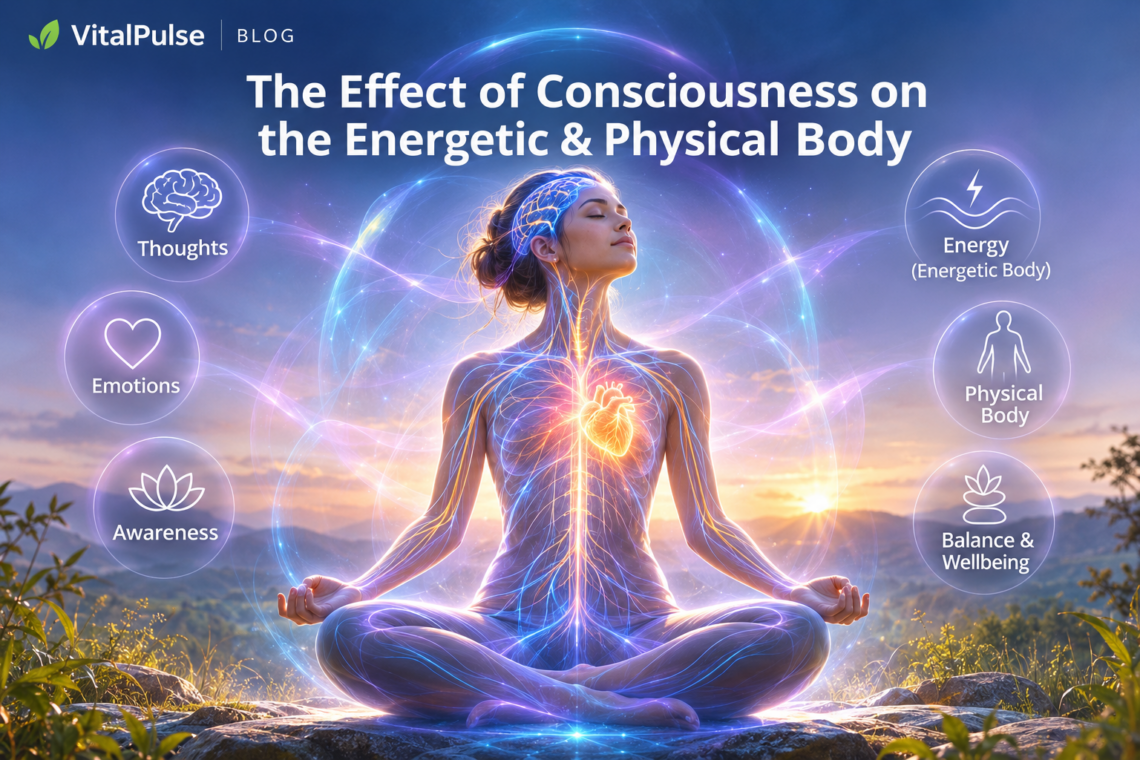
The Effect of Consciousness on the Energetic & Physical Body
How our thoughts, emotions, beliefs and awareness may influence the way we experience ourselves, our energy and our physical wellbeing.
Table of Contents
Mind-Body Connection: We Are More Than Our Physical Bodies
What if the way we think, feel, perceive and experience the world has a greater influence on our physical wellbeing than we realise?
Every moment of our lives is shaped by consciousness. Our thoughts influence our emotions, our emotions influence our behaviour, and our experiences influence how we respond to the world around us.
But the relationship goes deeper.
Our nervous system responds to our thoughts and perceptions. Our heart rate changes with our emotional state. Our breathing pattern shifts depending on whether we feel calm or threatened. Muscles tighten when we experience stress, while relaxation can encourage the body to move towards a more restorative state.
These examples demonstrate something important: the mind and body are not separate systems operating independently. They are continuously communicating and influencing one another.
Within holistic wellness traditions, this relationship is often explored through the concept of the physical and energetic bodies. The energetic body is understood as a subtle aspect of our being, associated with vitality, balance, emotional experience and the flow of life energy.
Although many aspects of the mind–body connection can be investigated scientifically, the exact nature of subtle energy fields and their relationship with consciousness remains an area of exploration.
At VitalPulse, we approach this subject with curiosity, recognising the value of both scientific understanding and holistic perspectives.
1. Understanding Consciousness
Consciousness can be understood as our awareness of ourselves and the world around us.
It encompasses our thoughts, feelings, perceptions, memories, intentions and sense of self.
It is not simply about thinking. It also involves how we interpret experiences, where we direct our attention and how we respond to what happens in our lives.
Consider two people experiencing the same stressful situation. One may respond with anxiety, tension and fear, while the other may remain relatively calm and approach the situation with confidence.
The external circumstances are similar, but their internal experiences are different.
This illustrates the importance of perception.
Our interpretation of an experience can influence the body’s physiological response. When we perceive danger or uncertainty, the nervous system may activate a stress response. When we feel safe and supported, the body may be better able to settle into a state of rest and recovery.
Consciousness therefore influences how we experience our environment and how our bodies respond to it.
2. The Connection Between Consciousness and the Physical Body
The physical body is an extraordinarily interconnected biological system.
The brain, nervous system, endocrine system, immune system and cardiovascular system constantly exchange information to maintain internal balance, known as homeostasis.
Our mental and emotional experiences form part of this communication.
The Nervous System
The autonomic nervous system regulates many automatic functions, including heart rate, digestion, breathing patterns and blood vessel activity.
It has two major branches:
Sympathetic nervous system – Fight or Flight
This system prepares the body to respond to perceived threats or demands.
It can increase:
- Heart rate and blood pressure.
- Muscle tension.
- Alertness and vigilance.
- The release of stress hormones.
- Energy availability for immediate action.
Parasympathetic nervous system – Rest and Digest
This system supports activities associated with restoration and maintenance.
It contributes to:
- Slowing the heart rate.
- Supporting digestive activity.
- Relaxation and recovery.
- Conserving energy.
- Maintaining normal bodily functions.
Both systems are essential. The goal is not to eliminate the stress response, but to maintain the flexibility to activate it when necessary and return to a calmer state afterwards.
When stress becomes prolonged, the body’s regulatory systems may remain under greater demand. This can influence sleep, digestion, muscle tension, mood and other aspects of wellbeing.
Our thoughts cannot directly control every bodily function, but the way we perceive and respond to life can influence the nervous system’s activity.
The Endocrine System and Hormones
The endocrine system communicates through chemical messengers called hormones.
When we experience stress, the hypothalamic-pituitary-adrenal (HPA) axis becomes involved in coordinating the body’s stress response.
This can lead to the release of cortisol and other stress-related hormones.
Short-term activation is a normal and necessary survival mechanism. However, prolonged stress can affect the body’s hormonal regulation and influence sleep, metabolism, immune activity and emotional wellbeing.
This is one of the clearest examples of how psychological experiences can influence physical processes.
The Immune System
Our immune system does not function in isolation.
It communicates with the nervous and endocrine systems through a complex network of chemical and biological signals.
Research into psychoneuroimmunology explores how psychological processes, the nervous system and immune function interact.
Chronic psychological stress can influence immune regulation and inflammatory processes. Researchers are also investigating how practices such as mindfulness, meditation and relaxation may affect these systems.
The relationship is complex, and no single thought or emotional state determines whether someone becomes ill or recovers from illness.
Nevertheless, the mind–body connection is an important part of understanding human wellbeing.
3. Consciousness and the Energetic Body
Beyond the physical body, many holistic traditions recognise an energetic dimension of human existence.
Different cultures have described this dimension using different terminology:
- Prana: Life force or vital energy in Indian traditions.
- Qi or Chi: Life energy in traditional Chinese philosophy and practices.
- Ki: A Japanese concept associated with vital energy.
- Biofield: A contemporary term used in some integrative health research and energy-based practices.
Although these concepts have different historical and philosophical foundations, they share an underlying perspective: living organisms can be understood as more than their physical structures alone.
Within energy-based wellness traditions, the energetic body is often viewed as an interconnected field associated with vitality, emotional balance and the experience of wellbeing.
Some approaches propose that thoughts, emotions and consciousness influence this energetic environment.
For example, prolonged emotional stress may be described within these traditions as energetic stagnation, imbalance or disruption.
Experiences of peace, compassion, gratitude and connection may, conversely, be associated with greater energetic harmony.
It is important to distinguish these interpretations from established biological mechanisms. The existence and precise functioning of a subtle human energy field, as described in many energy-healing traditions, have not been conclusively established by conventional scientific research.
However, biofield therapies are an active area of investigation, with researchers continuing to examine their possible effects and underlying mechanisms.
4. How Thoughts and Emotions Influence Our Energy
Have you ever noticed how different you feel after spending time with someone who makes you happy compared with someone whose presence leaves you feeling emotionally drained?
Or how a period of worry can leave you physically exhausted, even when you have not performed any strenuous activity?
These experiences highlight the close relationship between emotional states, physiological responses and perceived energy.
Let’s explore some examples.
Fear and Anxiety
Fear and anxiety can activate the body’s stress response.
You may experience:
- Increased heart rate.
- Shallow or rapid breathing.
- Muscle tension.
- Restlessness.
- Difficulty concentrating.
- Sleep disturbances.
From an energetic perspective, some traditions associate persistent fear with disrupted energy flow or a feeling of energetic contraction.
Anger and Frustration
Anger can trigger physiological changes associated with heightened arousal.
Breathing may become faster, muscles may tighten and cardiovascular activity may increase.
When frustration becomes persistent, it can contribute to emotional exhaustion and difficulty relaxing.
Holistic energy traditions often interpret unresolved anger as an imbalance in emotional and energetic expression.
Grief and Sadness
Emotional loss can affect the entire person.
Grief may influence appetite, sleep, motivation, concentration and physical energy.
It is not unusual to experience tiredness or a sense of heaviness during emotionally difficult periods.
From an energetic perspective, grief is sometimes described as a state in which vitality feels diminished.
This should not be understood as a personal failure or a sign of defective energy. Grief is a natural human experience that deserves compassion and time.
Gratitude, Compassion and Joy
Positive emotional experiences can support a sense of connection, safety and psychological wellbeing.
Feeling appreciated, spending time with loved ones, experiencing joy or practising gratitude may help improve mood and reduce perceived stress.
These experiences can also encourage behaviours that support physical wellbeing, such as social connection, movement, healthy routines and better stress management.
In holistic traditions, such emotions are often associated with energetic harmony and a greater sense of vitality.
The important point is that our emotional experiences matter. They are not simply abstract thoughts; they are accompanied by real changes in how we experience and respond to life.
5. The Power of Attention, Intention and Belief
Where we direct our attention can influence what we notice, how we interpret experiences and how we respond.
For example, constantly focusing on potential problems may reinforce feelings of uncertainty and vigilance. Becoming aware of these patterns can create an opportunity to respond differently.
Intention also plays an important role in personal wellbeing.
Setting an intention to slow down, improve sleep, become more physically active or manage stress can help guide everyday decisions.
Beliefs can influence our expectations and experiences too.
This is one reason researchers study the placebo and nocebo effects.
The placebo effect refers to improvements in symptoms that can occur partly through expectations and the context in which care is received. The nocebo effect describes the possibility that negative expectations may contribute to unpleasant symptoms or experiences.
Neither means that symptoms are imaginary. Expectations and context can influence genuine experiences through complex brain–body processes.
Our beliefs are not magical controls over biology, but they can form an important part of how we experience health and wellbeing.
6. Consciousness, Meditation and the Relaxation Response
One of the most practical ways to explore the connection between consciousness and the physical body is through mindfulness and meditation.
Mindfulness involves bringing attention to the present moment without immediately judging or reacting to what we experience.
Meditation can involve:
- Focused breathing.
- Body awareness.
- Observation of thoughts.
- Visualisation.
- Repetition of a calming word or phrase.
- Cultivation of compassion and gratitude.
These practices can help us become more aware of our thoughts, emotional responses and physical sensations.
Scientific research suggests that mindfulness and relaxation practices may help some people manage stress, anxiety and sleep difficulties.
Slow, controlled breathing may also influence physiological measures such as heart rate and blood pressure.
From an energetic perspective, meditation is often used to encourage a sense of centredness, balance and connection with the body.
Rather than viewing meditation as a way to force the body into a particular state, it can be approached as an opportunity to observe, acknowledge and gently regulate our experiences.
7. The Biofield: Where Consciousness and Energy Meet
The concept of the biofield provides another perspective on the relationship between consciousness and the human organism.
Within biofield-related traditions, the human body is viewed as existing within a broader energetic environment.
The term is also used in scientific and integrative health discussions, although there is no universally accepted definition or established mechanism explaining how a proposed subtle biofield operates.
It is useful to distinguish this concept from the measurable electrical and electromagnetic activity already known to occur in the body.
For example:
- The heart produces electrical activity that can be recorded using an electrocardiogram (ECG).
- The brain produces electrical activity that can be measured using an electroencephalogram (EEG).
- Nerves communicate using electrochemical signals.
- Muscles generate electrical activity during contraction.
These are established biological processes.
The proposed subtle biofield is a broader concept and should not be assumed to be identical to these measurable signals.
Some energy-based practitioners explore whether awareness, intention and emotional states may influence the biofield.
Research into Reiki, Therapeutic Touch, Healing Touch and other biofield-related practices continues, but the findings remain inconclusive for many proposed health effects.
For holistic wellness, the biofield provides an interesting framework for exploring human vitality, provided we remain open-minded while recognising the limitations of current evidence.
8. Bringing the Mind, Energy and Body Into Greater Harmony
The relationship between consciousness and wellbeing is not something that needs to be explored exclusively through meditation or energy-based practices.
It can also be cultivated through simple everyday choices.
Consider the following practices:
1. Develop Self-Awareness
Take a few moments each day to notice your thoughts, emotions and physical sensations.
Ask yourself:
- How am I feeling emotionally?
- Where am I holding physical tension?
- What has been occupying my thoughts?
- What do I need at this moment?
Awareness is often the first step towards meaningful change.
2. Practise Conscious Breathing
Spend five minutes breathing slowly and comfortably.
Allow your breathing to become gentle and natural without forcing deep breaths.
Notice how your body responds.
3. Make Space for Emotional Processing
Avoid treating emotions as something that must always be suppressed or corrected.
Journalling, creative activities, talking to someone you trust or seeking professional support can provide healthy opportunities to process difficult experiences.
4. Support Your Physical Body
Consciousness and energetic wellbeing should not be explored independently of physical health.
Prioritise:
- Adequate sleep.
- Balanced nutrition.
- Sufficient hydration.
- Gentle physical movement.
- Time outdoors.
- Meaningful social connection.
5. Create Moments of Stillness
Our daily lives can become filled with constant stimulation, responsibilities and distractions.
Allow yourself moments without screens, notifications or external demands.
Stillness can provide an opportunity to reconnect with your thoughts and physical sensations.
6. Cultivate Gratitude and Compassion
Notice small things that bring meaning, comfort or enjoyment into your life.
Practising gratitude does not mean ignoring difficulties. It means allowing positive experiences to exist alongside life’s challenges.
9. A Simple Consciousness and Body Awareness Exercise
The following exercise is designed to encourage greater awareness of the relationship between your thoughts, emotions and physical sensations.
Duration: 5–10 minutes.
Step 1 – Pause
Find a comfortable position and allow yourself to become still.
Step 2 – Observe Your Breathing
Notice the natural rhythm of your breathing.
Avoid trying to change it immediately. Simply observe.
Step 3 – Scan Your Body
Bring your awareness gently to different areas of your body.
Notice whether you experience tension, warmth, relaxation, discomfort or other sensations.
There is no need to judge what you notice.
Step 4 – Observe Your Emotional State
Ask yourself what you are feeling at this moment.
Are you calm, anxious, frustrated, tired, content or uncertain?
Allow the feeling to be acknowledged without immediately trying to change it.
Step 5 – Set an Intention
Choose a simple intention for yourself.
For example:
“I choose to approach myself with patience, awareness and compassion.”
Step 6 – Reflect
After the exercise, consider whether anything has changed.
Do you feel more aware of your body? Has your breathing changed? Has your emotional state shifted?
There is no right or wrong outcome. The purpose is simply to develop a closer relationship with your own experiences.
If focusing inward feels uncomfortable or increases anxiety, stop and return your attention to your surroundings.
10. The VitalPulse Perspective: Awareness as the Beginning of Wellbeing
At VitalPulse, we believe that wellbeing deserves to be explored from multiple perspectives.
The physical body, mental processes, emotional experiences and the energetic concepts found in holistic traditions can all form part of a broader conversation about human wellbeing.
Consciousness provides an opportunity to become more aware of these dimensions.
When we begin to recognise the relationship between our thoughts, emotions, habits and physical responses, we gain valuable insight into the way we experience life.
This does not mean that we can think ourselves out of every illness, control every biological process or prevent difficult experiences through positive thinking.
It means recognising that our internal experiences are important and that cultivating awareness can support healthier choices and a more balanced relationship with ourselves.
The energetic body remains an interesting area of exploration, while modern research continues to investigate the complex communication networks that connect our brain, nervous system, hormones and immune system.
Perhaps the most valuable place to begin is not by trying to change our energy, but by learning to understand ourselves more deeply.
Awareness creates the opportunity for change.
And sometimes, meaningful wellbeing begins with something as simple as pausing, breathing and paying attention.
Final Reflection
Take a moment to consider the following questions:
- How do your thoughts and emotions influence the way you feel physically?
- Do you notice changes in your energy levels during periods of stress or emotional difficulty?
- How often do you give yourself time to become aware of your body and emotional state?
- What small change could you introduce to support greater balance in your everyday life?
Remember: your wellbeing is not defined by one part of you. It is an ongoing relationship between your physical health, mental processes, emotional experiences, lifestyle and the way you connect with yourself and the world around you.
Reconnect. Reflect. Realign.
Explore Your Wellbeing with VitalPulse.
Important Wellness Disclaimer
The information provided in this article is intended for educational and general wellness purposes only. Concepts relating to consciousness, subtle energy and the energetic body include traditional and emerging perspectives that are not all scientifically established. Practices discussed here are not intended to diagnose, treat, cure or prevent any medical condition. Meditation, mindfulness and complementary wellness approaches should not replace appropriate medical assessment or treatment. Always consult a suitably qualified healthcare professional regarding health concerns.
References & Further Reading
- National Center for Complementary and Integrative Health (NCCIH). Meditation and Mindfulness: Effectiveness and Safety.
https://www.nccih.nih.gov/health/meditation-and-mindfulness-effectiveness-and-safety - National Center for Complementary and Integrative Health (NCCIH). Stress.
https://www.nccih.nih.gov/health/stress - Sprengel et al. (2025). Biofield Therapies Clinical Research Landscape: A Scoping Review and Interactive Evidence Map. Journal of Integrative and Complementary Medicine.
https://doi.org/10.1089/jicm.2024.0773 - Effects of Mind–Body Interventions on Immune and Neuroendocrine Functions: A Systematic Review and Meta-Analysis of Randomized Controlled Trials. Healthcare (2025).
https://doi.org/10.3390/healthcare13080952


You May Also Like

The Importance of Hydration

Cluster Headaches: Understanding the Pain, Triggers, Treatment and Natural Support