The Thymus Gland: Your Body’s Training Centre for the Immune System
Table of Contents
Understanding the thymus, its role in immune health, T-cells, stress, ageing and how to support your body’s natural defence system.
Introduction
Hidden behind your breastbone, just above your heart, is a small but remarkably important organ that plays a major role in your immune system: the thymus gland.
Although relatively small and often overlooked, the thymus is essential for developing one of the most important components of your immune defence system – T-lymphocytes, commonly known as T-cells.
These specialised white blood cells help your body recognise harmful invaders, coordinate immune responses and distinguish between your own healthy tissues and potentially dangerous foreign substances.
The thymus is particularly active during childhood and adolescence, but its influence on immune function extends throughout adulthood.
Understanding how this gland works provides an interesting insight into the relationship between immune health, ageing, nutrition, stress and overall wellbeing.
Let’s explore the thymus and what you can do to support your body’s natural immune function.
1. What Is the Thymus Gland?
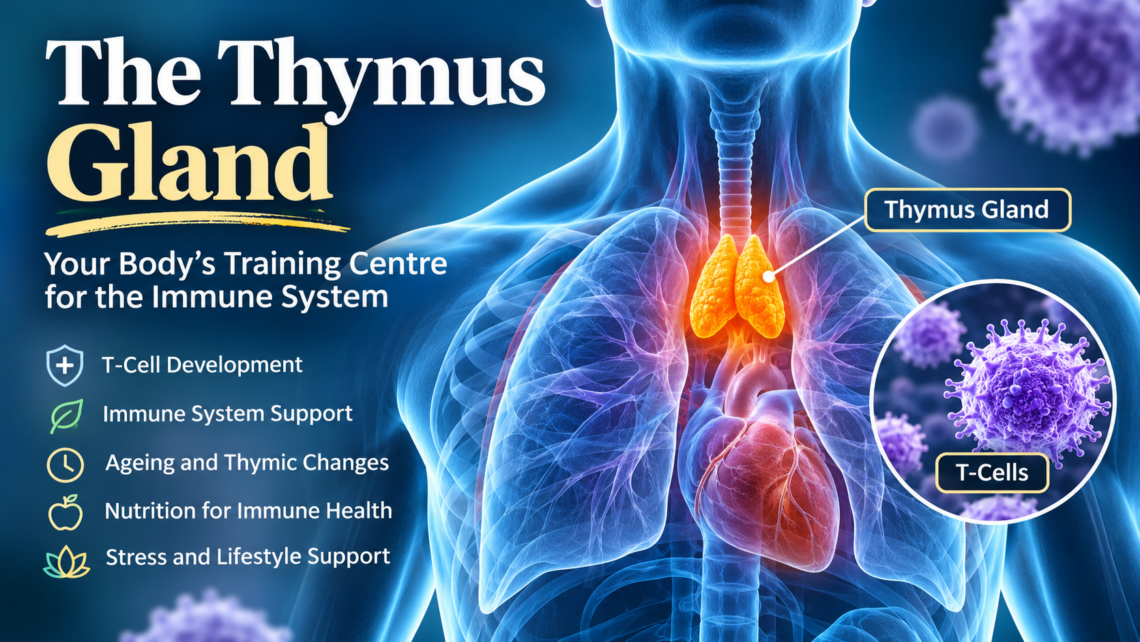
The thymus is a specialised lymphatic organ belonging to the immune and endocrine systems.
It is located in the upper chest, behind the sternum (breastbone), between the lungs and just above the heart.
Unlike many other organs, the thymus is most active during the early stages of life.
Its primary responsibility is to provide an environment where immature immune cells develop into mature, functional T-cells.
The thymus also produces several signalling substances, including thymic hormones and peptides, which participate in the development and regulation of immune function.
In simple terms: Think of the thymus as a training academy for your immune system. It helps educate immune cells so they can identify threats while learning not to attack your own healthy tissues.
2. Understanding T-Cells: The Immune System’s Specialised Defence Force
T-cells are a type of white blood cell that play a central role in adaptive immunity – the part of your immune system that learns to recognise specific threats.
They originate from stem cells in the bone marrow but travel to the thymus to mature.
Once they have completed their development, they enter circulation and populate different lymphatic tissues throughout the body.
There are several important types of T-cells:
Helper T-Cells (CD4+)
These cells act as coordinators of the immune response.
They communicate with other immune cells, helping organise the body’s response to infections and other threats.
Cytotoxic T-Cells (CD8+)
These specialised cells identify and destroy infected or abnormal cells, including certain virus-infected cells.
Regulatory T-Cells (Tregs)
These cells help control immune activity and prevent excessive immune responses.
They are particularly important in maintaining immune tolerance – the ability of your immune system to avoid attacking your own tissues.
Memory T-Cells
After encountering a particular threat, some T-cells remain in the body as memory cells.
They help the immune system respond more efficiently if it encounters the same threat again.
This ability to recognise previously encountered pathogens is an important feature of adaptive immunity.
3. The Thymus and Immune System Development
One of the thymus gland’s most important functions is something called T-cell selection.
Not every developing T-cell is suitable for release into circulation.
During maturation, developing T-cells undergo two important selection processes.
Positive Selection
T-cells must demonstrate that they can recognise the body’s own major histocompatibility complex (MHC) molecules. This is necessary for them to recognise antigens presented by other cells.
Negative Selection
T-cells that react too strongly against the body’s own tissues are generally eliminated or directed towards regulatory pathways.
This process helps reduce the risk of autoimmune reactions.
The thymus therefore plays an essential role in developing an immune system that is capable of defending the body without unnecessarily attacking itself.
When thymic function is severely impaired early in life, T-cell development can be significantly affected, potentially resulting in serious immune deficiencies.
4. What Happens to the Thymus as We Age?
One of the most fascinating characteristics of the thymus is that it gradually changes throughout our lives.
This process is known as thymic involution.
The thymus is relatively large and active during childhood. It reaches its greatest relative activity early in life and begins gradually shrinking as we grow older, particularly after puberty.
During this process:
- Functional thymic tissue gradually decreases.
- Some of the gland’s specialised tissue is replaced by fatty tissue.
- The production of new naïve T-cells declines.
- The diversity of newly generated T-cells can become more limited.
- The immune system becomes increasingly reliant on existing T-cell populations and immune memory.
Does this mean the thymus stops working when you reach adulthood?
No.
Although its activity declines, the thymus does not simply switch off. Some functional thymic tissue and T-cell production remain even in older adults.
This is important because the thymus continues contributing to immune system maintenance throughout life.
Research is also exploring ways to understand and potentially improve thymic regeneration, although there is currently no established, approved treatment that reliably reverses normal age-related thymic involution.
5. The Relationship Between Stress and the Thymus
Your immune system does not operate independently of your nervous and endocrine systems.
The body constantly communicates through hormones, chemical messengers and immune signalling molecules.
One particularly interesting connection involves the stress response.
When you experience prolonged physical or psychological stress, your body may produce increased amounts of stress hormones, including cortisol.
Cortisol is important for regulating inflammation and immune activity. However, sustained stress-related hormonal changes can influence immune-cell development and function.
Research has demonstrated that severe stress, systemic inflammation and certain illnesses can cause temporary thymic atrophy – a reduction in the size and cellular activity of the thymus.
This is different from normal age-related thymic involution, and some of these changes can recover when the underlying stressor or illness resolves.
How Chronic Stress May Influence Immune Health
Long-term stress can contribute to:
- Changes in immune signalling.
- Disrupted sleep and recovery.
- Altered inflammatory responses.
- Changes in immune-cell activity.
- Reduced resilience when dealing with physical and psychological challenges.
This is one reason why managing stress should be considered an important part of a holistic wellbeing routine.
Practical Ways to Support Nervous System Regulation
Consider incorporating the following practices into your daily routine:
- Slow breathing: Practise gentle diaphragmatic breathing for five minutes.
- Mindfulness: Spend time observing your thoughts, sensations and emotions without immediately reacting to them.
- Time outdoors: Get natural daylight and spend time in a peaceful outdoor environment.
- Gentle movement: Walking, stretching and mobility exercises can support general health.
- Sleep consistency: Maintain regular sleeping and waking times.
- Recovery periods: Allow yourself time to rest instead of remaining in a constant state of activity.
These practices support general health and stress regulation. They should not be interpreted as proven methods of directly enlarging or regenerating the thymus.
6. Nutrition and the Thymus: Giving Your Immune System What It Needs
Your immune system requires a steady supply of nutrients to develop, function and maintain its specialised cells.
The thymus is no exception.
Although no particular food can selectively activate the thymus, a balanced nutritional approach can help provide the building blocks required for normal immune function.
Here are some important nutrients to understand.
Protein
Protein supplies amino acids required for the production of immune cells, antibodies, enzymes and other essential structures.
Good sources include:
- Eggs.
- Fish.
- Chicken.
- Beans and lentils.
- Dairy products.
- Nuts and seeds.
Zinc
Zinc participates in immune-cell development, communication and normal immune function.
Food sources include:
- Pumpkin seeds.
- Meat.
- Seafood.
- Eggs.
- Legumes.
- Whole grains.
Vitamin A
Vitamin A plays an important role in maintaining healthy tissues and supporting immune-cell development and function.
Food sources include:
- Carrots.
- Sweet potatoes.
- Spinach.
- Pumpkin.
- Eggs.
- Liver.
Vitamin C
Vitamin C contributes to normal immune function and protects cells against oxidative stress.
Food sources include:
- Oranges.
- Guavas.
- Kiwi fruit.
- Peppers.
- Broccoli.
- Strawberries.
Vitamin D
Vitamin D participates in immune regulation and helps maintain healthy immune responses.
Sources include:
- Sensible sunlight exposure.
- Oily fish.
- Egg yolks.
- Fortified foods.
Vitamin D deficiency may require supplementation under appropriate guidance.
Selenium
Selenium is involved in antioxidant defence systems and the regulation of immune responses.
Food sources include:
- Fish.
- Eggs.
- Meat.
- Whole grains.
- Brazil nuts.
Be aware that Brazil nuts can contain very high and variable amounts of selenium. Eating large quantities regularly can lead to excessive intake.
Magnesium
Magnesium supports hundreds of biochemical processes, including normal nerve and muscle function and cellular energy production.
Food sources include:
- Pumpkin seeds.
- Spinach.
- Almonds.
- Beans.
- Whole grains.
A useful principle: Rather than concentrating on one miracle nutrient, aim for nutritional variety. The immune system depends on many interconnected nutrients working together.
7. The Thymus, Inflammation and Autoimmune Health
One of the most important responsibilities of the thymus is helping the immune system develop tolerance towards the body’s own tissues.
This is particularly relevant when discussing autoimmune conditions.
An autoimmune condition develops when the immune system mistakenly identifies certain components of the body as threats and mounts an inappropriate immune response.
The thymus helps reduce this risk through negative selection and the development of regulatory T-cells.
These mechanisms are not perfect, and autoimmune diseases involve multiple genetic, environmental and immunological factors.
It is important to understand that:
- The thymus is not the sole controller of autoimmune disease.
- Autoimmune conditions cannot be attributed simply to an unhealthy or underactive thymus.
- Supporting general immune health does not necessarily prevent or reverse autoimmune conditions.
The thymus is one part of a much larger regulatory network involving the bone marrow, lymph nodes, spleen, gut-associated immune tissues and other immune organs.
8. Practical Lifestyle Habits for Supporting Immune Health
You cannot consciously exercise your thymus gland in the same way that you exercise your muscles.
However, you can establish habits that support the overall environment in which your immune system functions.
Here are eight practical areas to focus on.
1. Prioritise Restorative Sleep
Sleep is an important part of immune regulation. Aim for approximately 7–9 hours of sleep each night if you are an adult.
2. Eat a Varied, Nutrient-Dense Diet
Include vegetables, fruit, adequate protein, whole grains, legumes and healthy fats.
3. Move Your Body Regularly
Walking, cycling, swimming and moderate resistance training can support general metabolic and immune health.
4. Avoid Smoking
Tobacco smoke exposes the body to numerous harmful chemicals and contributes to oxidative stress, inflammation and damage to respiratory and immune tissues.
Quitting smoking is one of the most valuable steps you can take towards improving your long-term health.
5. Moderate Alcohol Consumption
Alcohol can negatively influence immune function, particularly when consumed excessively.
6. Maintain a Healthy Gut Environment
Your gastrointestinal tract contains a substantial part of your immune system.
A varied, fibre-rich diet supports beneficial gut microorganisms and normal intestinal function.
7. Manage Chronic Stress
Build regular opportunities for relaxation, reflection and recovery into your day.
8. Address Nutritional Deficiencies
If you suspect a nutritional deficiency, appropriate testing and professional guidance are preferable to taking multiple supplements without knowing what you need.
These measures support overall immune health, rather than specifically targeting thymic regeneration.
9. Can You Stimulate or Reactivate the Thymus Gland?
This is a question that frequently appears in natural health and holistic wellbeing discussions.
There is growing scientific interest in thymic regeneration, particularly because the thymus gradually loses some of its functional capacity with age.
Researchers are investigating several potential approaches, including:
- Hormonal signalling pathways.
- Growth factors involved in thymic tissue repair.
- Regeneration of thymic epithelial cells.
- The influence of inflammation and metabolic health.
- Potential interventions to restore T-cell production.
Some experimental approaches have produced promising findings, but much of this research remains at the laboratory, animal-study or early clinical-investigation stage.
There is currently insufficient clinical evidence to recommend over-the-counter thymus extracts, glandular supplements, thymus massage or specific breathing techniques as proven methods of restoring thymic function.
It is also worth being cautious about products marketed as thymus activators or immune gland stimulants. A product claiming to regenerate the thymus should have credible human clinical evidence supporting that specific claim.
The most sensible approach is to concentrate on maintaining good overall health while allowing scientific research to continue exploring the possibilities of thymic regeneration.
10. Conditions Associated with the Thymus Gland
Although the thymus is relatively small, several medical conditions can affect it.
DiGeorge Syndrome
This is a genetic condition involving abnormal development of structures that originate from the embryonic pharyngeal pouches.
In some individuals, the thymus is underdeveloped or absent, resulting in impaired T-cell development and immune deficiency.
Thymoma
A thymoma is a relatively uncommon tumour originating from the epithelial cells of the thymus.
Some thymomas are associated with autoimmune conditions, particularly myasthenia gravis.
Myasthenia Gravis
Myasthenia gravis is an autoimmune disorder affecting communication between nerves and muscles.
Some people with this condition have thymic abnormalities, including thymic hyperplasia or thymoma.
Thymic Hyperplasia
This refers to an enlargement of the thymus or an increase in its lymphoid tissue.
It can occur in association with certain autoimmune conditions and other immune-related processes.
Not every enlarged thymus represents cancer or a serious medical problem. Proper medical assessment and imaging are important when abnormalities are suspected.
If you experience persistent muscle weakness, swallowing difficulties, unexplained breathing difficulties or other concerning symptoms, seek medical assessment rather than assuming the thymus is responsible.
11. A Simple Daily Immune-Support Routine
You don’t need an expensive supplement programme or complicated wellness protocol to start taking better care of your immune health.
Consistency matters more than complexity.
Here is a simple routine you can adapt to your circumstances.
| Time | Suggested Activity |
|---|---|
| Morning | Get natural daylight and drink water. |
| Breakfast | Eat a balanced meal containing protein and fibre. |
| During the day | Take short movement breaks and stay hydrated. |
| Afternoon | Go for a gentle walk or spend time outdoors. |
| Evening | Enjoy a balanced meal with vegetables and protein. |
| Before bed | Reduce screen stimulation and practise gentle breathing. |
Remember that these habits benefit your overall health. They are not a treatment for thymic disorders.
12. Reflection: Your Immune System Is a Living Network
The thymus provides a fascinating example of how interconnected the human body really is.
It does not work in isolation. Its development and activity are influenced by hormonal signals, immune communication, nutrition, inflammation and the ageing process.
This highlights an important principle of holistic wellbeing:
Health is not simply about supporting individual organs. It is about understanding the relationships between the different systems that keep the body functioning.
Your immune system, nervous system, endocrine system and digestive system are constantly communicating.
When we look after the body as an integrated whole, we create better conditions for normal physiological function.
You cannot control every aspect of ageing or immune activity, but you can make daily choices that support your long-term wellbeing.
Frequently Asked Questions
1. Does the thymus gland disappear after puberty?
No. It gradually decreases in size and becomes increasingly replaced by fatty tissue, but some functional thymic tissue generally remains throughout adulthood.
2. Can the thymus grow back?
The thymus has some regenerative capacity. Researchers are investigating ways to improve thymic regeneration, but there is currently no established lifestyle intervention or approved supplement that reliably reverses age-related thymic involution.
3. Does stress affect the thymus?
Yes. Severe physiological stress, systemic inflammation and certain hormonal changes can cause temporary thymic atrophy. Chronic stress can also influence broader immune regulation.
4. Can food improve thymus function?
A balanced diet provides nutrients necessary for normal immune-cell development and function. However, no particular food has been demonstrated to selectively reactivate the thymus.
5. Is the thymus connected to the heart?
The thymus is anatomically situated in front of and above the heart, behind the breastbone. It is not part of the heart, although the two organs occupy neighbouring areas of the chest.
6. Does the thymus control the entire immune system?
No. It is particularly important for T-cell development and immune tolerance, but the immune system involves many organs, tissues and specialised cells.
Final Thoughts
The thymus gland might be small, but its contribution to human health is enormous.
From educating immune cells during childhood to helping maintain immune competence throughout adulthood, it plays a fundamental role in protecting the body.
Perhaps the most interesting lesson is that immune health is not determined by one organ, one nutrient or one supplement.
It is the result of many interconnected processes working together.
At VitalPulse, we believe that understanding these connections is an important part of developing a more informed, balanced and holistic approach to wellbeing.
Explore your wellbeing. Reconnect. Reflect. Realign.
Further Reading & Scientific References
- Cleveland Clinic – https://my.clevelandclinic.org/health/body/23016-thymus-gland
- Nature Reviews Immunology – Research on thymic selection of T-cells.
- Frontiers in Immunology – Research on T-cell migration, selection and thymic atrophy.
- Aging Cell – Research on age-related thymic involution.
- Nature Reviews Immunology – Research on thymic regeneration and restoration of T-cell production.
VITALPULSE DISCLAIMER
This article is intended for general educational and informational purposes. It does not constitute medical advice, diagnosis or treatment. Nutritional and lifestyle recommendations are intended to support general wellbeing and should not replace appropriate medical care. Individuals with immune disorders or suspected thymic conditions should consult a qualified healthcare professional.