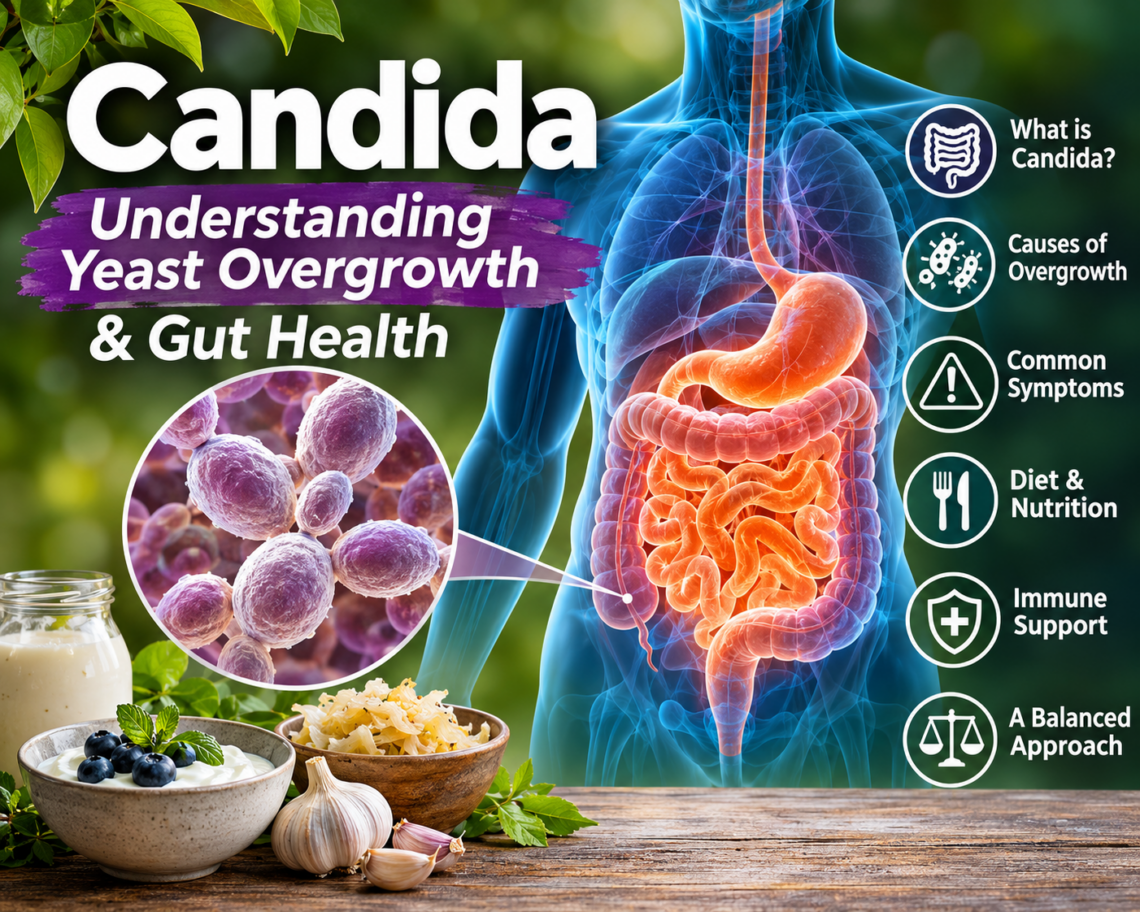
Candida: Understanding Yeast Overgrowth, Gut Health & Microbial Balance
VitalPulse | Explore Your Wellbeing
Reconnect. Reflect. Realign.
Table of Contents
Introduction: The Hidden World of Candida
Our bodies are home to trillions of microorganisms, including bacteria, fungi and other microscopic organisms. Together, they form a complex ecosystem known as the microbiome.
Most of the time, these organisms coexist in a delicate balance, supporting digestion, immune function and the health of our skin and mucous membranes.
One of these organisms is Candida, a naturally occurring yeast that lives in various parts of the human body.
Under normal circumstances, Candida does not cause problems. However, when conditions allow certain Candida species to multiply excessively or invade surrounding tissue, they can cause an infection known as candidiasis.
Candida is an interesting example of how the relationship between microorganisms and their human host can influence health.
Understanding Candida requires looking beyond the yeast itself and exploring the factors that influence microbial balance, immune function, gut health and the body’s natural defence mechanisms.
1. What Exactly Is Candida?
Candida is a genus of microscopic fungi belonging to the yeast family.
The most commonly recognised species is Candida albicans, although several other species can also cause infections.
Candida can naturally be found in:
- The digestive tract.
- The mouth and throat.
- The skin.
- The vaginal tract.
- Other mucous membrane surfaces.
Its presence does not automatically indicate a health problem.
In a healthy individual, the immune system, protective barriers and surrounding microbial communities help regulate Candida populations.
Problems arise when this relationship becomes disrupted, allowing Candida to cause an infection.
This distinction is important: simply detecting Candida does not necessarily mean that someone has candidiasis.
2. What Causes Candida to Overgrow?
Candida infections can develop when the normal protective mechanisms of the body are disrupted.
Several factors may contribute:
Antibiotic use
Antibiotics are designed to eliminate susceptible bacteria. Unfortunately, they can also reduce populations of beneficial bacteria that help regulate fungal growth.
This may create favourable conditions for Candida to multiply.
Weakened immune function
The immune system plays an important role in controlling fungal organisms.
People with compromised immunity, including those undergoing chemotherapy or taking certain immunosuppressive medications, may have an increased risk of candidiasis.
Elevated blood glucose
People with poorly controlled diabetes are more susceptible to certain Candida infections. Elevated glucose levels can influence the body’s ability to control fungal growth.
Hormonal changes
Pregnancy and certain hormonal changes can increase susceptibility to vaginal yeast infections.
Medication use
Corticosteroids, particularly inhaled steroids, can increase the risk of oral thrush in some individuals.
Disruption of the skin’s protective barrier
Moisture, friction and skin irritation can create favourable conditions for Candida-related skin infections.
Ultimately, Candida infections are influenced by several interacting factors rather than one single cause.
3. Understanding Candida and the Gut Microbiome
The digestive tract contains an enormous community of microorganisms.
This ecosystem includes:
- Beneficial bacteria.
- Other bacteria that coexist without necessarily causing harm.
- Fungi and yeasts.
- Viruses and other microscopic organisms.
Together, these organisms contribute to what is commonly called the gut microbiome.
Although bacteria receive much of the attention in discussions about gut health, fungi are also an important part of this ecosystem.
Candida is one of the fungi that can inhabit the gastrointestinal tract.
Research suggests that gut bacteria can help regulate fungal populations through competition for nutrients, the production of antimicrobial substances and interactions with the immune system.
When broad-spectrum antibiotics disrupt bacterial communities, Candida colonisation may increase.
However, an important distinction must be made:
Candida naturally occurring in the digestive tract is not the same thing as an active Candida infection.
There is also insufficient clinical evidence to support the idea that a broad collection of symptoms such as fatigue, brain fog, bloating, headaches and mood changes automatically indicates systemic Candida overgrowth.
Persistent digestive symptoms deserve proper investigation rather than an assumption that Candida is responsible.
4. Recognising the Symptoms of Candidiasis
The symptoms of Candida depend largely on where the infection develops.
Oral Candidiasis (Oral Thrush)
This occurs when Candida grows excessively in the mouth.
Possible symptoms include:
- White patches on the tongue or inside the cheeks.
- Redness and irritation.
- A cotton-like sensation in the mouth.
- Discomfort when eating or swallowing.
- Cracking at the corners of the mouth.
Oral thrush is more common in people with weakened immune systems, those using certain inhaled medications and people with uncontrolled diabetes.
Intestinal and Digestive Symptoms
Digestive complaints sometimes attributed to Candida include:
- Bloating.
- Excessive gas.
- Abdominal discomfort.
- Changes in bowel movements.
- Diarrhoea.
However, these symptoms are nonspecific and can be associated with numerous digestive conditions, including irritable bowel syndrome, food intolerances, constipation and other gastrointestinal disorders.
Candida in a stool sample does not, by itself, establish that Candida is responsible for digestive symptoms.
A less common condition called small intestinal fungal overgrowth (SIFO) has been investigated in selected patients with persistent gastrointestinal symptoms. Its diagnosis requires specialised assessment.
Vaginal Candidiasis
Common symptoms include:
- Vaginal itching and irritation.
- Redness and swelling.
- Thick, white vaginal discharge.
- Burning during urination.
- Discomfort during sexual intercourse.
These symptoms can overlap with other vaginal infections, making accurate diagnosis important.
Skin Candidiasis
Candida can also cause infections in warm, moist areas of the body.
Common locations include:
- Skin folds.
- Under the breasts.
- The groin.
- Between the fingers and toes.
- Around the nappy area in infants.
Symptoms may include redness, itching, irritation and a rash.
5. Candida, Sugar and Nutrition
Diet is frequently discussed in relation to Candida.
Candida is a yeast, and certain sugars can support its growth under laboratory conditions. However, this does not mean that eating sugar automatically causes Candida infections in humans.
People with poorly controlled diabetes have an increased risk of certain Candida infections, which highlights the importance of metabolic health and blood glucose regulation.
A balanced nutritional approach can support general health and immune function.
Consider the following principles:
Reduce excessive added sugar
Limit sugary drinks, sweets and highly processed foods. This supports overall nutritional and metabolic health.
Increase dietary fibre
Vegetables, legumes, whole grains and other fibre-containing foods help support beneficial gut bacteria.
Include adequate protein
Protein provides essential building blocks for tissue maintenance and immune function.
Eat a variety of whole foods
A varied diet supplies vitamins, minerals, fibre and other nutrients that contribute to normal physiological function.
Stay adequately hydrated
Water supports normal digestion, circulation and numerous cellular processes.
There is currently no strong clinical evidence that a restrictive Candida diet can reliably eliminate intestinal Candida or treat candidiasis.
Severely restricting carbohydrates or eliminating entire food groups is generally unnecessary and may create nutritional problems.
6. The Relationship Between Candida and the Immune System
The immune system is one of the body’s most important mechanisms for controlling fungal organisms.
It includes several layers of defence:
Physical barriers
The skin and mucous membranes help prevent microorganisms from entering deeper tissues.
Innate immunity
Immune cells such as neutrophils and macrophages recognise and respond to invading microorganisms.
Adaptive immunity
Specialised immune cells help coordinate targeted responses against particular organisms.
Candida interacts with these defence systems in complex ways.
For example, certain immune pathways, including Th17 responses, play an important role in protecting mucosal surfaces against fungal infections.
When these protective mechanisms are compromised, the likelihood of certain Candida infections increases.
This is one reason why supporting general immune health through adequate nutrition, sleep and appropriate medical care is important.
7. Supporting a Healthy Gut Environment
Rather than focusing exclusively on eliminating one microorganism, it is useful to consider the overall health of the digestive ecosystem.
Some practical approaches include:
1. Support microbial diversity
Eat a varied diet containing different plant foods, vegetables, fruit, legumes and whole grains as tolerated.
2. Include fermented foods
Foods such as plain yoghurt with live cultures, kefir and certain fermented vegetables can provide beneficial microorganisms.
These foods can form part of a healthy diet, although they are not established treatments for Candida infections.
3. Support regular bowel movements
Adequate fluid intake, dietary fibre and gentle physical activity can support normal bowel function.
4. Prioritise sleep
Sleep contributes to normal immune regulation, hormonal balance and metabolic health.
5. Manage chronic stress
Prolonged stress can influence digestive function, sleep and immune regulation.
Breathing exercises, mindfulness, gentle movement and relaxation practices may help support overall wellbeing.
6. Avoid unnecessary antibiotics
Antibiotics should be used when medically indicated, rather than for suspected fungal problems.
8. Candida Treatment: What Actually Works?
An important part of understanding Candida is recognising when medical treatment is necessary.
Candidiasis is a recognised fungal infection, and appropriate antifungal medication is the established treatment.
Depending on the location and severity, treatment may involve:
- Antifungal creams.
- Antifungal oral gels.
- Antifungal tablets.
- Other prescription antifungal medications.
The correct medication depends on the infection, the Candida species involved and the individual’s circumstances.
Recurring infections, persistent symptoms or treatment failure may require further testing.
It is also important to avoid taking antifungal medication without appropriate guidance. Some antifungals can interact with other medications and may have side effects.
What About Natural Candida Remedies?
Natural health approaches frequently mention:
- Garlic.
- Oregano oil.
- Coconut oil.
- Probiotics.
- Apple cider vinegar.
- Herbal antifungal preparations.
Some of these substances have demonstrated antimicrobial properties in laboratory research.
However, laboratory activity does not necessarily translate into effective or safe treatment in humans.
There is insufficient clinical evidence to recommend these remedies as substitutes for established antifungal treatment.
Essential oils and concentrated herbal preparations can also cause irritation or adverse reactions.
A balanced approach is to use nutrition and lifestyle practices as supportive measures, not as replacements for appropriate diagnosis and treatment.
9. Candida and the Importance of Looking at the Bigger Picture
Candida provides an interesting opportunity to explore the interconnected nature of human health.
The body does not operate as a collection of isolated systems.
The digestive system, immune system, endocrine system and nervous system continuously interact.
For example:
- The gut microbiome interacts with the immune system.
- Blood glucose regulation influences susceptibility to certain infections.
- Hormonal changes can influence the vaginal environment.
- Medication use can alter microbial communities.
- Sleep and stress influence several aspects of physiological regulation.
This interconnectedness is an important principle in holistic wellbeing.
However, it is equally important not to assume that every symptom has the same underlying cause.
Bloating, fatigue, skin irritation and digestive discomfort can have many different explanations.
The goal should be to investigate symptoms carefully, understand the contributing factors and choose appropriate interventions.
10. When Should You Seek Medical Advice?
Consider seeking medical assessment if you experience:
- Persistent or recurring thrush.
- Repeated vaginal yeast infections.
- Persistent digestive discomfort.
- Difficulty swallowing or painful swallowing.
- Unexplained skin rashes that do not improve.
- Symptoms of Candida alongside poorly controlled diabetes.
- Persistent symptoms despite antifungal treatment.
People with weakened immune systems should seek medical advice promptly if they develop symptoms suggesting a fungal infection.
Invasive candidiasis, which can affect the bloodstream and internal organs, is a serious medical condition most commonly associated with people who are already critically ill or have significant healthcare-related risk factors. Fever and chills in someone at risk require urgent medical assessment.
Conclusion: Balance Rather Than Elimination
Candida is not inherently harmful. It is a naturally occurring member of the human microbial ecosystem.
Problems arise when particular species cause an infection, often in circumstances where normal protective mechanisms have been disrupted.
Understanding this distinction allows us to move away from fear-based approaches to gut health and towards a more balanced understanding of the body’s internal environment.
At VitalPulse, we believe wellbeing begins with awareness, education and a willingness to explore the factors influencing our health.
Rather than searching for a single organism to blame, we can take a broader approach: supporting digestive health, maintaining balanced nutrition, caring for the immune system and recognising when professional medical guidance is needed.
The goal is not to eliminate every microorganism. It is to understand the relationship between our bodies and the microscopic world within them.
VitalPulse Reflection
Take a moment to consider:
- How well do I understand the relationship between my digestive system and my overall wellbeing?
- Have I recently used antibiotics or medication that may influence my microbial balance?
- Am I supporting my body through adequate nutrition, hydration, sleep and stress management?
- Are persistent symptoms being properly investigated rather than self-diagnosed?
Small, informed changes can be the beginning of a more conscious relationship with your health.
VitalPulse – Explore Your Wellbeing.
Reconnect. Reflect. Realign.
Medical Disclaimer
This article is intended for general educational purposes and does not constitute medical advice, diagnosis or treatment. Candida colonisation is not necessarily an infection, and nonspecific symptoms should not automatically be attributed to Candida overgrowth. Always consult a qualified healthcare professional for persistent or recurring symptoms. Do not discontinue prescribed medication or replace recommended antifungal treatment with dietary or alternative remedies.
References and Further Reading
- World Health Organization (WHO) – Candidiasis (Yeast Infection): https://www.who.int/news-room/fact-sheets/detail/candidiasis-(yeast-infection)
- Centers for Disease Control and Prevention (CDC) – Candidiasis Basics: https://www.cdc.gov/candidiasis/about/
- CDC – Testing and Diagnosis of Candidiasis: https://www.cdc.gov/candidiasis/testing/
- CDC – Treatment of Candidiasis: https://www.cdc.gov/candidiasis/treatment/
- Mishra, A.A. & Koh, A.Y. (2021). The microbial and host factors that govern Candida gastrointestinal colonization and dissemination. Current Opinion in Microbiology, 63, 29–35.
- Nature Reviews Gastroenterology & Hepatology – Commensal Fungi in Intestinal Health and Disease (2023).