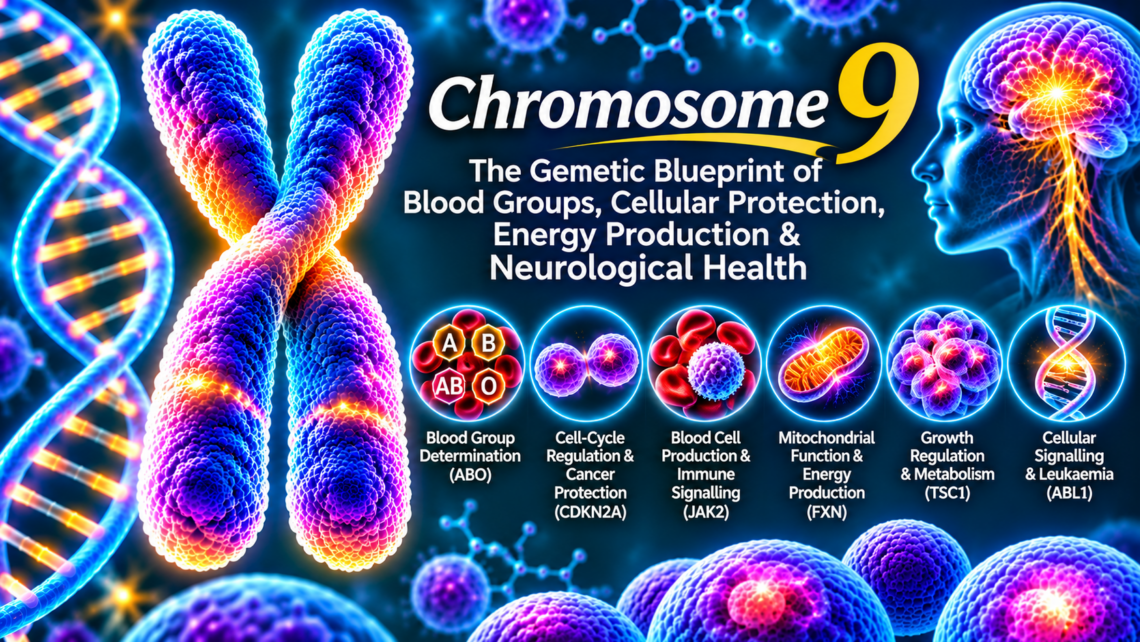
Chromosome 9: The Genetic Blueprint of Blood Groups, Cellular Protection, Energy Production & Neurological Health
Exploring the fascinating relationship between chromosome 9, blood group determination, cellular growth, mitochondrial function, immune signalling, neurological health and the body’s biological maintenance systems.
Introduction: The Ninth Chapter of Our Genetic Blueprint
Our DNA contains an extraordinary amount of information. Within every cell, chromosomes organise this information into structures that guide growth, development, cellular activity and the maintenance of life.
Among the 23 pairs of human chromosomes, Chromosome 9 has a particularly fascinating collection of genes.
It contains genetic instructions involved in several important biological processes, including:
- Blood group determination.
- Regulation of cellular growth and division.
- Blood cell production.
- Immune and inflammatory signalling.
- Mitochondrial function and energy metabolism.
- Neurological development and maintenance.
- DNA regulation and cellular protection.
- Organ development and tissue maintenance.
One of its most recognisable genes is ABO, which determines the ABO blood group system: A, B, AB or O.
Another important gene is CDKN2A, which produces proteins that help regulate the cell cycle and prevent uncontrolled cellular growth.
Chromosome 9 also contains JAK2, involved in blood cell production and immune signalling; TSC1, which helps regulate cellular growth through the mTOR pathway; and FXN, which is essential for mitochondrial iron-sulphur cluster formation.
These genes demonstrate how chromosome 9 contributes to the relationship between cellular identity, energy production, blood function and biological regulation.
Let’s explore its structure, important genes, associated conditions and fascinating connections to holistic wellbeing.
1. Understanding Chromosome 9
Humans normally have 46 chromosomes, arranged into 23 pairs. One chromosome in each pair is inherited from the mother and the other from the father.
Chromosome 9 contains approximately 141 million DNA base pairs and represents around 4.5% of the total DNA found in human cells.
It is estimated to contain approximately 800 to 900 protein-coding genes, although gene counts vary depending on the reference and counting methods used.
Like other chromosomes, chromosome 9 has two main arms:
- 9p (short arm): The smaller arm of the chromosome.
- 9q (long arm): The larger arm of the chromosome.
The letter p comes from the French word petit, meaning small, while q identifies the longer arm.
Several important genetic regions are distributed along these arms.
For example:
- 9p21.3 contains the CDKN2A and CDKN2B genes.
- 9p24.1 contains JAK2.
- 9q21.11 contains FXN.
- 9q22.3 contains PTCH1.
- 9q31.1 contains TSC1.
- 9q32 contains the ABO gene.
- 9q34.12 contains ABL1.
- 9q34.3 contains EHMT1.
The location of these genes is important because changes affecting particular regions can influence different biological processes.
2. The Biological Functions of Chromosome 9
Chromosome 9 contributes to several interconnected biological systems.
Its genes participate in blood group determination, cellular growth regulation, blood cell production, mitochondrial function and neurological maintenance.
Blood Groups and Cellular Identity
One of the most recognisable genes on chromosome 9 is ABO, located at position 9q34.2.
ABO provides instructions for producing an enzyme involved in the formation of A and B blood group antigens.
These antigens are carbohydrate structures found on the surface of red blood cells and certain other tissues.
The ABO gene determines which antigen is expressed.
There are three major versions, or alleles, commonly discussed:
- A.
- B.
- O.
The A and B alleles produce enzymes with different activities, while the common O allele produces an enzyme with little or no functional activity.
The combinations inherited from both parents determine the ABO blood group.
For example:
- A and A can produce blood group A.
- A and O can produce blood group A.
- B and O can produce blood group B.
- A and B can produce blood group AB.
- O and O can produce blood group O.
The ABO system is particularly important in blood transfusion because incompatible blood groups can trigger serious immune reactions.
Another important aspect is that ABO blood groups are inherited independently of the Rh blood group system, which is determined primarily by the RHD gene on chromosome 1.
The ABO gene therefore provides an interesting example of how genetic information contributes to individual biological identity.
Cellular Growth and Protection Against Uncontrolled Division
One of the most important genes on chromosome 9 is CDKN2A, located at position 9p21.3.
CDKN2A provides instructions for producing two particularly important proteins:
- p16INK4a.
- p14ARF.
Both proteins function as tumour suppressors, helping prevent cells from growing and dividing in an uncontrolled manner.
The p16INK4a protein regulates the activity of CDK4 and CDK6, two proteins involved in controlling progression through the cell cycle.
By inhibiting these proteins, p16INK4a helps prevent inappropriate cell division.
The p14ARF protein participates in another protective pathway involving p53, an important regulator of cellular responses to DNA damage and other forms of cellular stress.
Together, these proteins help coordinate:
- Cell-cycle regulation.
- Cellular senescence.
- Responses to DNA damage.
- Control of abnormal cell proliferation.
- Maintenance of tissue stability.
Cellular senescence is a process in which cells permanently stop dividing while remaining metabolically active.
It is one of the mechanisms that helps prevent damaged or potentially dangerous cells from continuing to multiply.
Changes affecting CDKN2A can increase susceptibility to certain cancers, including melanoma and pancreatic cancer.
This gene demonstrates how chromosome 9 contributes to the biological protection mechanisms that help maintain healthy tissues.
Blood Cell Production and Cellular Signalling
Another important gene is JAK2, located at position 9p24.1.
JAK2 provides instructions for producing Janus kinase 2, an enzyme involved in intracellular signalling.
It is particularly important in the JAK-STAT signalling pathway.
This pathway allows cells to respond to external signals such as hormones, growth factors and cytokines.
JAK2 participates in processes associated with:
- Blood cell production.
- Red blood cell development.
- Platelet production.
- Immune signalling.
- Cellular growth and differentiation.
- Regulation of inflammatory responses.
JAK2 is especially important in the response to erythropoietin, a hormone that stimulates the production of red blood cells.
It also participates in signalling associated with thrombopoietin, which influences platelet production.
Certain acquired mutations in JAK2 can cause excessive activation of the signalling pathway.
The JAK2 V617F mutation is associated with several myeloproliferative neoplasms, including polycythaemia vera, essential thrombocythaemia and primary myelofibrosis.
These conditions involve abnormal production of blood cells in the bone marrow.
JAK2 therefore provides an important connection between chromosome 9, blood formation and cellular communication.
Mitochondrial Function and Cellular Energy
The FXN gene, located at position 9q21.11, provides instructions for producing a protein called frataxin.
Frataxin is important for mitochondrial function, particularly the formation of iron-sulphur clusters.
Iron-sulphur clusters are essential components of several proteins involved in:
- Mitochondrial energy production.
- Cellular respiration.
- Electron transport.
- Enzyme activity.
- Iron metabolism.
Mitochondria are structures within cells responsible for producing much of the energy required for normal cellular activity.
They contain specialised systems that convert nutrients into ATP, the main energy-carrying molecule used by cells.
Frataxin helps maintain mitochondrial processes that depend on properly functioning iron-sulphur proteins.
Changes affecting FXN can cause Friedreich ataxia, an inherited neurological condition.
This condition can affect movement, coordination, sensation and cardiovascular function.
The FXN gene demonstrates how chromosome 9 contributes to the relationship between mitochondrial activity, cellular energy and neurological health.
Regulation of Cellular Growth and the mTOR Pathway
Another fascinating gene on chromosome 9 is TSC1, located at position 9q34.13.
TSC1 provides instructions for producing a protein called hamartin.
Hamartin works together with tuberin, which is produced by the TSC2 gene on chromosome 16.
Together, these proteins form a complex that helps regulate the mTOR signalling pathway.
The mTOR pathway is involved in:
- Cell growth.
- Protein synthesis.
- Nutrient sensing.
- Cellular metabolism.
- Cell survival.
- Regulation of autophagy.
Autophagy is a cellular process through which cells break down and recycle damaged or unnecessary components.
The TSC1-TSC2 complex helps prevent excessive activation of mTOR signalling.
When TSC1 function is disrupted, cellular growth regulation can become abnormal.
Disease-causing changes affecting TSC1 can cause tuberous sclerosis complex, a genetic condition characterised by the development of non-cancerous growths in different organs.
This gene provides an important connection between chromosome 9, nutrient sensing, cellular growth and metabolic regulation.
3. Important Genes Found on Chromosome 9
Chromosome 9 contains numerous genes with different biological functions.
The following examples illustrate some of its most important contributions.
| Gene | Primary biological role |
|---|---|
| ABO | Blood group determination |
| CDKN2A | Cell-cycle regulation and tumour suppression |
| CDKN2B | Regulation of cellular growth |
| JAK2 | Blood cell production and cellular signalling |
| FXN | Mitochondrial iron-sulphur cluster formation |
| TSC1 | Regulation of the mTOR pathway |
| ABL1 | Cellular signalling and regulation of cell growth |
| PTCH1 | Hedgehog signalling and embryonic development |
| EHMT1 | Epigenetic regulation and gene expression |
| NOTCH1 | Cell differentiation and tissue development |
Together, these genes demonstrate how chromosome 9 contributes to the functioning of multiple interconnected biological systems.
4. Chromosome 9 and Genetic Health Conditions
Changes affecting chromosome 9 can sometimes influence normal biological development and cellular function.
These changes may involve individual genes, deletions, duplications, translocations or other structural rearrangements.
Several recognised conditions are associated with chromosome 9.
Friedreich Ataxia
Friedreich ataxia is an inherited neurological condition associated with changes affecting the FXN gene.
Most cases involve an expansion of a repeated DNA sequence consisting of GAA units within the gene.
This can reduce the production of frataxin.
Reduced frataxin affects mitochondrial iron-sulphur cluster formation and normal cellular function.
Possible manifestations include:
- Progressive difficulties with coordination.
- Problems with balance.
- Muscle weakness.
- Reduced reflexes.
- Speech difficulties.
- Sensory abnormalities.
- Cardiomyopathy in some individuals.
The condition demonstrates the importance of mitochondrial function in maintaining healthy nervous system activity.
Tuberous Sclerosis Complex
Tuberous sclerosis complex is associated with disease-causing changes in either TSC1 on chromosome 9 or TSC2 on chromosome 16.
The condition affects the regulation of the mTOR signalling pathway.
It can result in the development of non-cancerous growths, called hamartomas, in different organs.
Possible manifestations include:
- Skin abnormalities.
- Seizures.
- Kidney lesions.
- Brain abnormalities.
- Heart tumours, particularly in infancy.
- Lung involvement in some individuals.
- Developmental and behavioural differences.
The severity varies considerably between individuals.
Chronic Myeloid Leukaemia
Chronic myeloid leukaemia is associated with a chromosomal rearrangement involving chromosomes 9 and 22.
This rearrangement is written as t(9;22).
Part of the ABL1 gene on chromosome 9 becomes fused with part of the BCR gene on chromosome 22.
The resulting fusion gene is called BCR-ABL1.
It produces an abnormal protein with excessive tyrosine kinase activity.
This protein sends signals that encourage abnormal blood cell proliferation.
The resulting abnormal chromosome 22 is known as the Philadelphia chromosome.
Importantly, this rearrangement generally develops during a person’s lifetime in blood-forming cells. It is not usually inherited.
Melanoma and CDKN2A
Certain inherited changes affecting CDKN2A can increase susceptibility to familial melanoma.
Melanoma is a type of skin cancer involving pigment-producing cells called melanocytes.
CDKN2A normally helps regulate cellular growth and prevent uncontrolled cell division.
When its tumour-suppressing function is reduced, the risk of certain cancers can increase.
Inherited CDKN2A variants can also be associated with increased pancreatic cancer risk in some families.
Kleefstra Syndrome
Kleefstra syndrome is most commonly associated with a deletion affecting chromosome 9q34.3 or a disease-causing variant in EHMT1.
EHMT1 provides instructions for producing an enzyme involved in histone methylation and epigenetic regulation.
Changes affecting this gene can disrupt normal gene expression during development.
Possible characteristics include:
- Developmental delays.
- Intellectual disability.
- Speech and language difficulties.
- Low muscle tone.
- Behavioural differences.
- Distinctive physical features.
This condition demonstrates the importance of epigenetic regulation during human development.
Gorlin Syndrome
Gorlin syndrome, also known as nevoid basal cell carcinoma syndrome, is associated with disease-causing changes affecting PTCH1 on chromosome 9.
PTCH1 plays an important role in the Hedgehog signalling pathway, which helps regulate embryonic development and cellular growth.
Possible characteristics include:
- Increased risk of basal cell carcinomas.
- Jaw cysts.
- Skeletal abnormalities.
- Calcification of certain brain structures.
- Other developmental differences.
The condition illustrates the importance of carefully regulated growth signalling.
Chromosome 9 Deletions and Duplications
Sections of chromosome 9 can sometimes be missing or present in additional copies.
These changes can influence different biological systems depending on which genes are affected.
Examples include:
- 9p deletion syndromes.
- 9q22.3 microdeletion syndrome.
- 9q34.3 microdeletion syndrome.
- Partial trisomy 9.
- Mosaic trisomy 9.
Possible manifestations include developmental delays, growth abnormalities, neurological differences and distinctive physical characteristics.
5. Chromosome 9 and the Relationship Between Cellular Identity and Protection
One of the most fascinating aspects of chromosome 9 is the way its genes participate in maintaining cellular identity and biological stability.
The ABO gene determines which blood group antigens are expressed on the surface of red blood cells.
CDKN2A helps regulate when cells should grow and divide.
JAK2 allows cells to respond to external signalling molecules.
TSC1 helps coordinate cellular growth with nutrient availability.
FXN contributes to the mitochondrial processes required for energy production.
Although these genes perform very different functions, they illustrate an important biological principle:
The body depends on the ability of cells to maintain their identity, regulate their activity and respond appropriately to their environment.
This coordination is essential for healthy tissue development and long-term biological function.
6. Chromosome 9 Through a Holistic Wellbeing Perspective
From a holistic wellbeing perspective, chromosome 9 offers an opportunity to explore several interconnected dimensions of human biology.
These include cellular protection, blood health, energy production, metabolic regulation and neurological maintenance.
It is important to distinguish established genetic science from complementary and symbolic interpretations.
Cellular Protection and Regulation
The CDKN2A gene demonstrates the importance of controlling cellular growth.
Cells must be able to divide when necessary while preventing damaged or abnormal cells from multiplying uncontrollably.
General practices that support long-term health include:
- Avoiding smoking.
- Protecting the skin from excessive ultraviolet exposure.
- Maintaining a balanced nutritional intake.
- Prioritising sufficient sleep.
- Participating in appropriate physical activity.
- Following recommended health screening.
These practices support general health rather than specifically targeting CDKN2A.
Blood Health and Circulation
The ABO and JAK2 genes provide an opportunity to explore the importance of blood and its role in maintaining the internal environment.
Blood transports oxygen, nutrients, hormones and other substances throughout the body.
It also participates in immune defence, temperature regulation and the maintenance of fluid balance.
General practices that support cardiovascular health include appropriate physical activity, balanced nutrition, avoiding smoking and managing blood pressure.
Blood group is genetically determined and cannot be changed through lifestyle practices.
Mitochondrial Function and Energy Production
The FXN gene highlights the importance of mitochondrial function.
Mitochondria help convert nutrients into usable cellular energy.
Their functioning depends on multiple biological systems, including oxygen availability, nutrient metabolism and the activity of specialised proteins.
General practices that support metabolic health include:
- Regular physical activity.
- Balanced nutritional habits.
- Adequate sleep.
- Avoiding smoking.
- Allowing sufficient recovery after physical exertion.
These practices support general metabolic wellbeing rather than specifically targeting frataxin or correcting FXN variants.
Metabolic Regulation and Cellular Renewal
The TSC1 gene provides an opportunity to explore the relationship between nutrient sensing, cellular growth and autophagy.
Cells constantly monitor their environment and adjust their activities according to nutrient availability and other signals.
Autophagy is one of the processes through which cells recycle certain damaged or unnecessary components.
It is a normal biological mechanism, not simply a detoxification process.
Maintaining general metabolic health through appropriate nutrition, movement and sleep supports the wider biological systems involved in cellular maintenance.
7. An Epigenetic Perspective: The Regulation of Genetic Information
One of the most fascinating aspects of modern biology is the growing understanding that genes do not operate independently.
Their activity is influenced by several regulatory mechanisms.
Epigenetics describes mechanisms that influence gene activity without changing the underlying DNA sequence.
These mechanisms include:
- DNA methylation.
- Histone modifications.
- Chromatin remodelling.
- Regulatory RNA molecules.
Chromosome 9 provides several interesting examples of epigenetic regulation.
EHMT1 and Histone Modification
The EHMT1 gene provides instructions for producing an enzyme that modifies histone proteins.
Histones help organise DNA within the nucleus of a cell.
Chemical modifications to histones influence how accessible particular sections of DNA are for gene activity.
EHMT1 is therefore important for the regulation of gene expression during development.
Changes affecting this gene can cause Kleefstra syndrome.
CDKN2A and Cellular Senescence
CDKN2A produces proteins involved in cellular senescence.
This is a biological process through which cells stop dividing under certain conditions.
Cellular senescence can help prevent damaged cells from continuing to multiply.
The regulation of CDKN2A is therefore relevant to ageing research, tissue maintenance and cancer biology.
TSC1 and Cellular Nutrient Sensing
TSC1 participates in the regulation of the mTOR pathway.
This pathway helps cells respond to nutrient availability and growth signals.
It connects metabolic conditions with cellular activity, protein synthesis and autophagy.
Our genetic blueprint provides the instructions, while gene regulation and cellular signalling help determine how those instructions are used.
8. An Esoteric and Symbolic Interpretation of Chromosome 9
Beyond conventional genetics, chromosome 9 can also be explored through a symbolic or esoteric lens.
This is not an established scientific interpretation of chromosome function. Rather, it is a reflective framework inspired by the biological processes associated with chromosome 9.
Considering its involvement in blood groups, cellular protection, energy production, growth regulation and biological identity, several symbolic themes emerge.
The Principle of Identity
The ABO gene determines the expression of important blood group antigens.
Symbolically, this can represent identity, individuality and the recognition of what makes each person unique.
It raises an interesting question:
How clearly do I understand and honour my own identity?
The Principle of Protection
The CDKN2A gene participates in mechanisms that prevent uncontrolled cellular growth.
Symbolically, chromosome 9 can represent protection, boundaries and the importance of preserving what supports life.
This can be explored through the question:
What aspects of my life require stronger boundaries or greater protection?
The Principle of Energy
The FXN gene contributes to mitochondrial processes involved in cellular energy production.
Symbolically, this can represent vitality, motivation and the relationship between available energy and meaningful action.
It invites reflection on how we use our physical, mental and emotional resources.
The Principle of Regulation
The TSC1 gene helps regulate cellular growth and nutrient responses.
Symbolically, this can represent moderation, balance and the importance of knowing when to act and when to pause.
The Principle of Renewal
Cellular senescence, autophagy and DNA maintenance demonstrate how biological systems continually manage damage and renewal.
Symbolically, chromosome 9 can represent restoration, preservation and the ability to move forward without losing the foundations that support us.
These interpretations can be used as tools for personal reflection without suggesting that chromosome 9 determines personality, emotional patterns or spiritual development.
9. Supporting the Biological Systems Associated With Chromosome 9
Although no lifestyle practice can specifically strengthen or repair chromosome 9, several general wellbeing practices support the biological systems in which its genes participate.
Support cardiovascular and blood health
- Maintain regular physical activity.
- Eat a varied and balanced diet.
- Avoid smoking.
- Monitor blood pressure when appropriate.
- Seek medical advice for persistent symptoms or abnormal blood results.
Support mitochondrial and metabolic health
- Maintain appropriate physical activity.
- Prioritise sufficient sleep.
- Eat a balanced diet.
- Allow adequate recovery.
- Avoid unnecessary supplementation.
Support cellular health
- Avoid tobacco exposure.
- Protect skin from excessive ultraviolet radiation.
- Maintain appropriate health screening.
- Prioritise rest and recovery.
- Limit unnecessary exposure to harmful environmental substances.
Support neurological health
- Maintain consistent sleep routines.
- Participate in activities that encourage learning.
- Engage in appropriate movement.
- Maintain meaningful social connections.
- Seek medical advice for persistent neurological symptoms.
These practices support general health and wellbeing rather than targeting any particular chromosome or gene.
10. Reflective Questions for Personal Wellbeing
The biological themes associated with chromosome 9 provide several interesting starting points for self-reflection.
Consider the following questions:
- How clearly do I recognise and honour my own identity?
- Am I protecting my physical and emotional wellbeing through appropriate boundaries?
- How effectively do I manage my energy and recovery?
- Do I maintain a healthy balance between growth, activity and rest?
- What areas of my life require greater regulation or structure?
- What would renewal and restoration look like in my everyday life?
These questions are not genetic assessments. They are intended to encourage greater awareness of the relationship between everyday choices and overall wellbeing.
Conclusion: A Blueprint of Identity, Protection and Renewal
Chromosome 9 is an important component of the human genetic blueprint.
Its genes contribute to blood group determination, cellular growth regulation, blood cell production, mitochondrial function, neurological health and the maintenance of genetic information.
From ABO and CDKN2A to JAK2, FXN, TSC1 and ABL1, chromosome 9 demonstrates how diverse biological processes depend on the coordinated activity of our genes.
Perhaps its most interesting lesson is the relationship between identity and regulation.
Cells must maintain their specialised characteristics, produce energy, respond to biological signals and protect themselves against inappropriate growth.
The body depends on continuous processes of maintenance, adaptation and renewal.
Through the lens of holistic wellbeing, chromosome 9 offers an opportunity to explore the themes of identity, protection, vitality, balance and restoration.
Understanding our biology can help us appreciate the extraordinary complexity of the human body and encourage a more informed, thoughtful approach to wellbeing.
Frequently Asked Questions About Chromosome 9
What does chromosome 9 do?
Chromosome 9 contains genes involved in blood group determination, cellular growth regulation, blood cell production, mitochondrial function, neurological health and embryonic development.
How many genes are found on chromosome 9?
Chromosome 9 is estimated to contain approximately 800 to 900 protein-coding genes, although estimates vary depending on the reference and counting methods used.
Which important genes are located on chromosome 9?
Some important genes include ABO, CDKN2A, CDKN2B, JAK2, FXN, TSC1, ABL1, PTCH1 and EHMT1.
Is chromosome 9 responsible for blood groups?
Yes. The ABO gene on chromosome 9 determines the ABO blood group system, which includes A, B, AB and O. The Rh blood group system is primarily determined by genes on chromosome 1.
Is chromosome 9 involved in cancer?
Yes. CDKN2A is an important tumour suppressor gene, while ABL1 can become part of the BCR-ABL1 fusion gene involved in chronic myeloid leukaemia. Changes affecting chromosome 9 have also been identified in several other cancers.
Is chromosome 9 involved in energy production?
Yes. The FXN gene produces frataxin, a protein important for mitochondrial iron-sulphur cluster formation and cellular energy-related processes.
What is the relationship between chromosome 9 and Friedreich ataxia?
Friedreich ataxia is associated with abnormal GAA repeat expansions in the FXN gene on chromosome 9. These changes reduce frataxin production and affect mitochondrial function.
Is chromosome 9 involved in blood cell production?
Yes. The JAK2 gene participates in signalling pathways that regulate the production of red blood cells and platelets.
Can lifestyle influence chromosome 9?
Lifestyle factors cannot normally change a person’s inherited chromosome 9 DNA sequence. However, environmental and lifestyle influences can affect gene expression and the biological systems in which chromosome 9 genes participate.
Important Medical Disclaimer
This article is intended for educational and general wellbeing purposes only. It does not provide medical diagnosis, treatment recommendations or genetic counselling.
Chromosomal abnormalities and genetic conditions require appropriate clinical assessment and, where indicated, genetic testing.
The holistic and symbolic interpretations presented in this article are reflective concepts and should not be confused with established genetic science.
For personal medical concerns, consult a qualified healthcare professional.
VitalPulse – Explore Your Wellbeing.
Reconnect. Reflect. Realign.