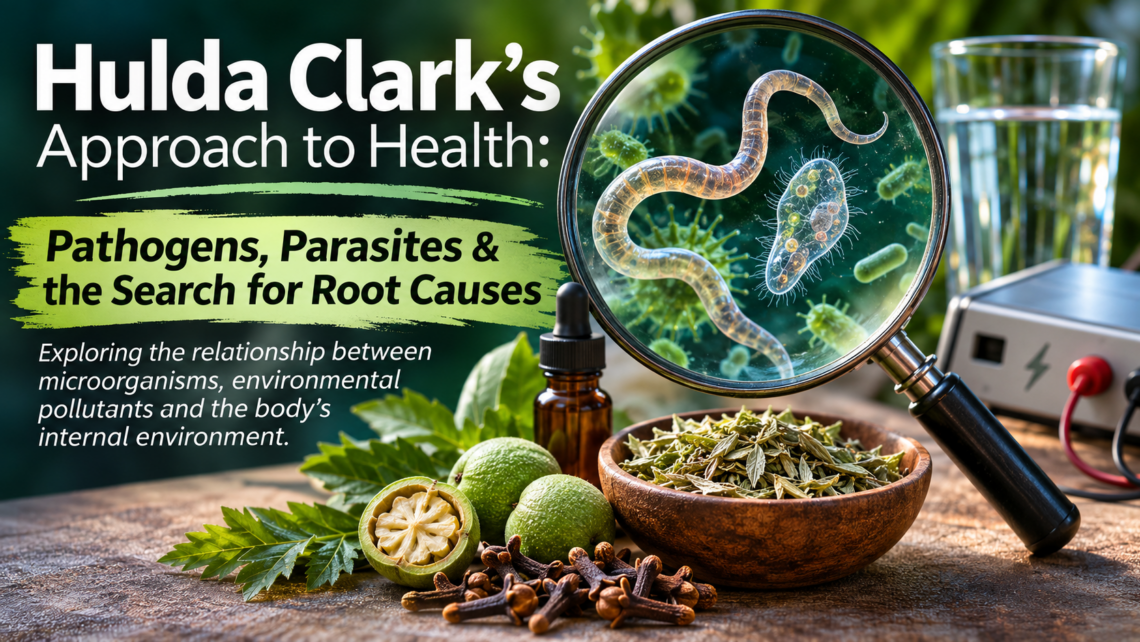
Hulda Clark’s Approach to Health: Pathogens, Parasites & The Search for Root Cause
Exploring the relationship between microorganisms, environmental pollutants and the body’s internal environment.
Table of Contents
Introduction: What If We Looked Deeper at the Causes of Illness?
Throughout history, people have searched for ways to understand why the body becomes unwell. While modern medicine has made tremendous progress in identifying microorganisms, understanding infections and developing treatments, some alternative health researchers have explored additional theories about the relationship between pathogens, environmental exposures and human health.
One of the more controversial figures in this field was Dr. Hulda Regehr Clark (1928–2009), an alternative health researcher and author who developed a theory that many diseases could be traced back to two underlying factors: parasites and environmental pollutants.
Her ideas challenged conventional thinking and introduced several alternative approaches, including herbal parasite cleansing, electrical stimulation devices and methods of identifying microorganisms through frequency-based testing.
But what exactly did she believe? What role did she attribute to pathogens? And how do her theories compare with our current understanding of health?
Let’s explore.
1. Who Was Hulda Clark?
Hulda Clark was a researcher and author who became widely known through her books, including:
- The Cure for All Cancers
- The Cure for All Diseases
- The Cure for HIV/AIDS
Clark developed a theory that many chronic illnesses and diseases were associated with parasites and chemical pollutants within the body.
Her approach was based on the idea that the body could be supported by identifying and addressing unwanted microorganisms and reducing exposure to substances she believed interfered with normal biological function.
Her work became particularly associated with three areas:
- Identifying parasites and other microorganisms.
- Reducing exposure to environmental pollutants.
- Attempting to eliminate unwanted organisms using herbal preparations and electrical devices.
It is important to understand that her broader claims, particularly that parasites were responsible for cancer and many unrelated diseases, have not been supported by reliable clinical evidence.
2. The Two Main Causes According to Hulda Clark
Clark’s central theory proposed two major contributors to disease:
A. Parasites and Other Pathogens
Clark believed that microorganisms, particularly intestinal parasites, played a much greater role in human illness than was generally recognised.
She placed particular emphasis on the intestinal fluke, Fasciolopsis buski, which she believed was associated with a wide range of diseases.
She proposed that parasites could inhabit different organs and contribute to various health conditions.
From her perspective, eliminating these organisms was an essential part of restoring health.
What does modern science tell us?
There is no doubt that pathogens can cause disease.
These include:
- Parasites: Organisms that live in or on another organism and obtain nourishment from it.
- Bacteria: Single-celled microorganisms, some of which cause infections.
- Viruses: Infectious agents that reproduce inside living cells.
- Fungi: Organisms that include yeasts and moulds, some of which can cause infections.
Examples of established pathogen-related diseases include malaria, tuberculosis, influenza, intestinal worm infections and candidiasis.
However, not all diseases are caused by pathogens. Many conditions involve a combination of genetic, metabolic, immune, environmental and lifestyle factors.
This distinction is important when exploring Clark’s theories.
Further reading: CDC – About Parasites.
B. Environmental Pollutants
The second major component of Clark’s theory involved environmental chemicals and pollutants.
She believed that exposure to certain chemicals could interfere with the body’s natural functioning and make it more susceptible to disease.
She discussed substances associated with:
- Household cleaning products.
- Industrial chemicals.
- Heavy metals.
- Contaminated food and water.
- Pesticides and other environmental chemicals.
- Certain materials used in everyday household products.
Although Clark’s specific explanations have not been scientifically established, the broader subject of environmental health is important.
Modern research recognises that certain environmental exposures can affect biological processes, including:
- Hormonal regulation.
- Immune function.
- Liver and kidney function.
- Cellular processes.
- Neurological health.
- Metabolic function.
The important distinction is that environmental exposures have different effects depending on the substance, concentration, duration and individual circumstances.
Reducing unnecessary exposure to known harmful substances is a sensible component of preventive health.
3. The Hulda Clark Parasite Cleanse
One of Clark’s best-known recommendations was a herbal parasite-cleansing combination consisting of three ingredients:
Black Walnut Hull
Black walnut hull was traditionally used in herbal preparations associated with intestinal cleansing.
Clark incorporated it into her parasite-cleansing programme because she believed it could help eliminate parasitic organisms.
Wormwood
Wormwood (Artemisia absinthium) is a medicinal herb with a long history of traditional use.
It has historically been associated with digestive health and traditional preparations for intestinal worms.
However, traditional use does not establish that a particular preparation safely eliminates parasites in humans.
Cloves
Cloves (Syzygium aromaticum) are aromatic flower buds commonly used in cooking and traditional herbal preparations.
They contain naturally occurring compounds, including eugenol, which has been investigated for various biological properties.
Clark believed that the combination of these three ingredients could address different stages of parasite development.
An important safety consideration:
The effectiveness of this particular cleansing protocol has not been established through adequate clinical trials. Herbal products can also cause adverse effects, allergic reactions and interactions with medication.
It is therefore not advisable to follow historical cleansing instructions or dosages without professional guidance.
Further reading: NCCIH – Herbs and Medication Interactions.
4. The Clark Zapper: Could Electrical Frequencies Affect Pathogens?
Perhaps the most recognisable aspect of Hulda Clark’s work was the development of the Clark Zapper.
The device was designed around her belief that microorganisms emit characteristic electrical or electromagnetic frequencies.
Clark proposed that applying electrical stimulation could selectively destroy unwanted microorganisms without harming surrounding human tissue.
The underlying idea was that different organisms have different frequency characteristics and that these characteristics could potentially be used to target them.
This concept was closely related to the broader alternative-health interest in bioelectrical activity, frequency-based approaches and Rife technology.
How was it supposed to work?
According to Clark’s theory:
- Microorganisms produce characteristic frequency signals.
- Electrical stimulation can interact with these signals.
- Applying the appropriate electrical conditions can disrupt or destroy the microorganisms.
- Reducing the microbial burden would support the body’s recovery.
However, there is currently no reliable clinical evidence demonstrating that the Clark Zapper kills parasites, bacteria or viruses inside the human body or treats disease.
The distinction between measurable electrical activity in living organisms and the ability to selectively eliminate pathogens through an external electrical device is extremely important.
Read more: Science Feedback – Hulda Clark’s Zapper and the Scientific Evidence.
5. The Syncrometer: Detecting Pathogens Through Frequency-Based Testing
Another device associated with Clark was the Syncrometer.
Clark claimed that this instrument could identify microorganisms, parasites and chemical substances by comparing electrical responses.
Her approach involved using reference samples and interpreting changes in the instrument’s response.
The idea was that substances and microorganisms could be recognised through their characteristic electrical properties.
This formed an important part of her overall approach because she believed that identifying the underlying problem was the first step towards addressing it.
However, the Syncrometer has not been validated as a diagnostic instrument through reliable clinical studies.
Today, suspected parasitic infections are investigated using recognised laboratory methods, which may include:
- Stool examinations.
- Blood tests for specific infections.
- Microscopic examination.
- Antigen or antibody testing.
- Imaging where clinically indicated.
Different parasites require different diagnostic approaches.
Reference: CDC – Diagnosis of Parasitic Diseases.
6. Why Pathogens Matter in the Bigger Picture of Health
While Clark’s broad conclusions remain unproven, the relationship between microorganisms and human health is a legitimate and important area of research.
Our bodies are home to enormous communities of microorganisms, collectively known as the microbiome.
These communities include bacteria, fungi, viruses and other microscopic organisms.
They exist in different parts of the body, including:
- The digestive tract.
- The skin.
- The mouth.
- The respiratory tract.
- The reproductive tract.
Not all microorganisms are harmful.
In fact, many play essential roles in maintaining normal biological function.
For example, beneficial intestinal bacteria contribute to:
Digestive function: They help break down certain food components that our digestive enzymes cannot fully process.
Nutrient production: Some intestinal microorganisms produce vitamins and other useful metabolites.
Immune regulation: The microbiome interacts with the immune system and contributes to its development and regulation.
Protection: Established microbial communities can help prevent certain harmful organisms from becoming established.
An imbalance in microbial communities is commonly referred to as dysbiosis.
Dysbiosis has been associated with various health conditions, although an association does not automatically mean that microbial imbalance is the original cause of a condition.
This is why it is important to understand the difference between maintaining a healthy microbiome and attempting to eliminate all microorganisms.
A healthy body does not need to be sterile. It needs a balanced biological environment.
7. Supporting the Body’s Natural Defences
Rather than focusing exclusively on eliminating microorganisms, we can take a broader approach to maintaining the body’s natural protective systems.
Several fundamental lifestyle factors contribute to normal immune and metabolic function.
Nutrition
A balanced diet provides the vitamins, minerals, proteins, fats and other nutrients required for normal cellular and immune function.
Prioritise a variety of vegetables, fruits, legumes, whole grains and appropriate protein sources.
Hydration
Water supports circulation, digestion, temperature regulation and normal kidney function.
Maintaining adequate hydration is an important foundation of general wellbeing.
Gut Health
A varied, fibre-rich diet can support the beneficial microorganisms living in the digestive tract.
Fermented foods may also contribute useful microorganisms, depending on the food and preparation.
Sleep and Recovery
Sleep is essential for normal immune regulation, hormonal balance and tissue recovery.
Consistently poor sleep can negatively affect several systems involved in maintaining health.
Environmental Awareness
Reducing unnecessary exposure to known harmful substances is worthwhile.
Simple measures include ventilating living spaces, following chemical product instructions, avoiding tobacco smoke and using appropriate protective equipment when handling household chemicals.
Gentle Movement
Regular physical activity supports cardiovascular health, metabolic function and general wellbeing.
It does not need to be excessive. Consistency is more important than intensity.
8. What Can We Learn From Hulda Clark’s Approach?
Perhaps the most valuable way to explore Clark’s work is to separate the questions she raised from the conclusions she reached.
Her approach encourages us to consider several interesting subjects:
- How do microorganisms influence human health?
- How does environmental exposure affect biological processes?
- What role does the gut microbiome play in wellbeing?
- How does the immune system maintain balance?
- How can we distinguish between beneficial and harmful microorganisms?
- How do we evaluate emerging approaches to health objectively?
These are worthwhile questions.
However, we must also recognise that a theory cannot be considered scientifically established simply because it offers an explanation for many different symptoms.
A reliable health approach requires appropriate testing, reproducible research, safety assessments and independent clinical evidence.
The fact that something has an interesting theoretical explanation does not necessarily mean that it works in practice.
9. The VitalPulse Perspective: Balance, Awareness and Informed Exploration
At VitalPulse, we believe that understanding health requires looking at the body as an interconnected system.
The immune system, digestive system, nervous system, metabolism and environment all contribute to our overall wellbeing.
We can explore subjects such as microbial balance, environmental health, bioelectrical activity and complementary wellness approaches without automatically accepting every theory or dismissing every question.
Hulda Clark’s work is an interesting example of how alternative health researchers attempted to understand disease through a pathogen-centred model.
However, her claims that parasites and pollutants are the underlying causes of virtually all diseases, and that her devices could eliminate these causes, have not been established by credible clinical evidence.
At the same time, the legitimate science of infectious disease, microbiome research, environmental health and immune function continues to expand our understanding of the human body.
Our philosophy is simple:
Explore with curiosity. Reflect with awareness. Realign with knowledge.
Wellbeing is not about finding one hidden cause for every condition. It is about understanding the many factors that influence the body and making informed decisions that support long-term health.
Final Thoughts
The human body is an extraordinarily complex biological system.
Microorganisms, environmental exposures, nutrition, genetics, metabolic processes and immune regulation all contribute to the health of that system.
Hulda Clark’s theories offer an interesting historical perspective on alternative approaches to pathogens, but they should not be confused with established medical science.
Rather than searching for one universal solution, we can learn to appreciate the complexity of the body and explore its interconnected systems with an open but critical mind.
Your wellbeing journey begins with understanding.
VitalPulse – Explore Your Wellbeing.
Reconnect. Reflect. Realign.
Curious About NLS Bioresonance Scanning?
What if you could explore your body’s energetic patterns from a different perspective?
At VitalPulse, we invite you to discover NLS (Non-Linear System) Bioresonance Scanning – an alternative wellness exploration approach designed to provide insights into energetic patterns and potential areas of imbalance within the body’s systems.
Whether you’re interested in understanding your wellbeing more deeply, exploring the body’s interconnected systems, or simply curious about complementary approaches to wellness, an NLS scan offers an opportunity to explore a different perspective.
Why not experience it for yourself?
✨ Explore your body’s energetic patterns.
✨ Discover a different perspective on your overall wellbeing.
✨ Identify areas you may wish to explore further as part of your personal wellness journey.
🎁 Take the First Step – Explore NLS Bioresonance!
👉 EXPLORE NLS BIORESONANCE SCANNING
VitalPulse – Explore Your Wellbeing.
Reconnect. Reflect. Realign.
Please note: NLS Bioresonance scanning is offered as a complementary wellness exploration service. It is not a medically validated diagnostic tool and does not diagnose, treat, cure or prevent disease. It is not a substitute for professional medical advice, diagnosis or treatment.
Important Health Disclaimer
This article is intended for educational and informational purposes only. It does not constitute medical advice, diagnosis or treatment. Hulda Clark’s theories and associated devices have not been established as effective treatments for infectious diseases or other medical conditions. Herbal parasite cleanses and electrical devices should not be used as substitutes for appropriate medical assessment and evidence-based treatment. Never delay or discontinue prescribed treatment because of alternative health claims. Consult a qualified healthcare professional regarding suspected infections, supplements or health concerns.