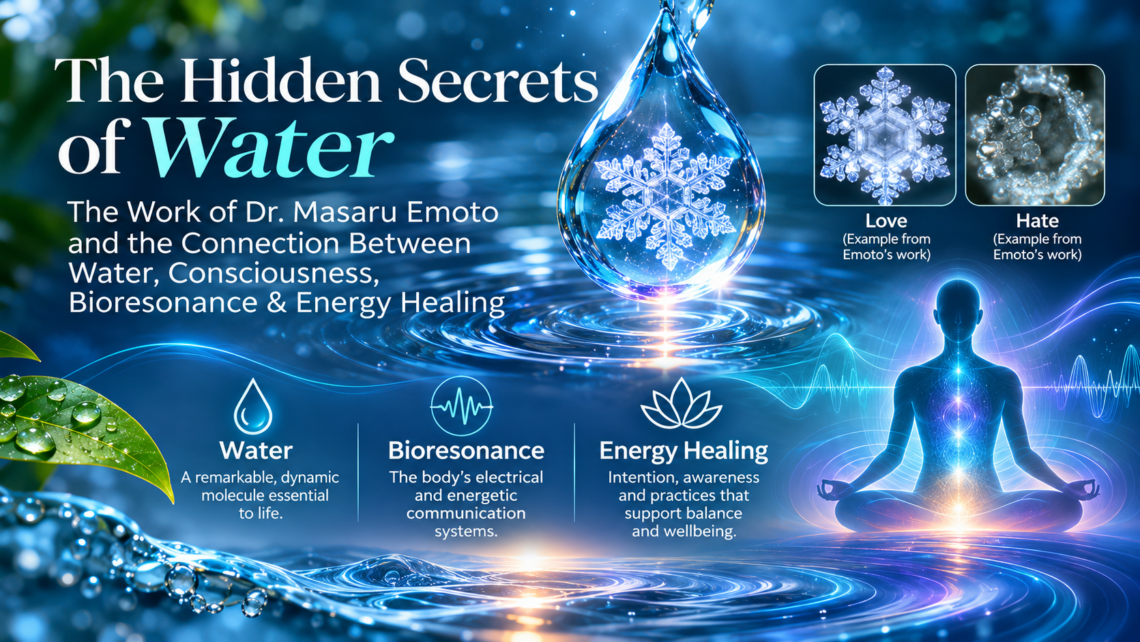
The Hidden Secrets of Water: The Work of Dr. Masaru Emoto and the Connection Between Water, Consciousness, Bioresonance & Energy Healing
Exploring the fascinating relationship between water, vibration, intention and the possibility that our environment influences the world within us.
Table of Contents
Water is one of the most extraordinary substances on Earth. It makes up a significant portion of the human body, supports virtually every biological process and is essential to life as we know it. Yet, beyond its familiar physical properties, water has inspired some fascinating questions about the relationship between energy, vibration, consciousness and living organisms.
One person who brought these questions into the public eye was Japanese researcher and author Dr. Masaru Emoto.
Through a series of experiments involving frozen water crystals, Emoto proposed that human emotions, thoughts, words and intentions could influence the physical appearance of water crystals. His work became widely known for its striking photographs of ice crystals exposed to different words, music and environmental influences.
Although his findings remain scientifically controversial, they raise interesting questions about the relationship between our thoughts, our surroundings and our wellbeing.
At VitalPulse, we can use this topic as an opportunity to explore a broader concept: how energy, environmental influences and the body’s own communication systems may interact.
Could water offer us a fascinating way to think about the connection between the physical and energetic aspects of life?
Let’s explore.
1. Who Was Dr. Masaru Emoto?
Dr. Masaru Emoto (1943–2014) was a Japanese author and researcher best known for his work exploring water crystals and the proposed relationship between human consciousness and water.
His internationally recognised books, particularly The Hidden Messages in Water, introduced millions of people to the idea that water might respond to its environment in ways that extend beyond conventional physical and chemical explanations.
Emoto developed a technique known as water crystal photography. His method involved exposing water samples to different environmental influences, freezing droplets and photographing the resulting crystals under a microscope.
He compared water exposed to:
- Positive and negative words.
- Classical music and other musical styles.
- Expressions of gratitude and love.
- Anger, criticism and negative language.
- Prayer and focused intention.
The photographs appeared to show differences in the shapes of the resulting ice crystals.
According to Emoto’s interpretation, water exposed to positive influences tended to form beautiful, symmetrical and intricate crystals, whereas water exposed to negative influences tended to produce irregular or less symmetrical formations.
His central proposition was fascinating:
If water responds to information and environmental influences, could the same principle help us understand the relationship between consciousness, energy and the human body?
2. The Famous Water Crystal Experiments
One of Emoto’s most widely discussed experiments involved placing different words on bottles of water.
Some bottles were labelled with positive expressions such as:
- Love
- Gratitude
- Thank You
- Peace
- Appreciation
Other bottles were exposed to negative expressions such as:
- Hate
- Anger
- You Fool
- I Hate You
The water was subsequently frozen, and the resulting crystals were photographed.
Emoto reported that water exposed to positive words and intentions produced more aesthetically pleasing crystal formations.
He also explored the influence of music, exposing water samples to different musical compositions before freezing them.
What Did the Experiments Suggest?
Emoto interpreted his observations as evidence that water could respond to information beyond its immediate chemical environment.
His work popularised the concept that intention, emotion and environmental influences might have an energetic relationship with matter.
There is, however, an important distinction between an interesting hypothesis and an established scientific finding.
A 2006 double-blind pilot study by Dean Radin, Gail Hayssen, Masaru Emoto and Takashige Kizu investigated whether distant positive intention could influence the aesthetic ratings of water crystals. The researchers reported a statistically significant result in favour of the treated samples.
A subsequent triple-blind study, published in the Journal of Scientific Exploration, also reported a positive result. However, methodological concerns and the lack of convincing independent reproducibility mean that these findings do not establish that human thoughts alter water’s molecular structure.
This does not make the subject uninteresting. It simply means we should remain curious while distinguishing established science from experimental claims.
3. Water: A Remarkable Molecular Structure
To appreciate why Emoto’s ideas attracted so much attention, it helps to understand what makes water so unusual.
Water is made up of two hydrogen atoms bonded to one oxygen atom (H₂O).
However, its behaviour is far more complex than this simple chemical formula suggests.
Water molecules are polar, meaning they have an uneven distribution of electrical charge. This allows neighbouring molecules to attract one another through hydrogen bonding.
These interactions create a constantly changing three-dimensional network.
This network is responsible for many of water’s remarkable properties, including:
- Its ability to dissolve a wide range of substances.
- Its role in transporting nutrients and waste products.
- Its unusual temperature-regulating properties.
- Its involvement in biochemical reactions.
- Its ability to interact with proteins, membranes and other biological structures.
Importantly, this molecular network is dynamic. Hydrogen bonds continually break and reform, allowing water to respond to temperature, pressure, dissolved substances and its surroundings.
Modern spectroscopy and molecular research provide extensive evidence for these constantly changing interactions.
This is an established area of science and provides a fascinating starting point for exploring water’s importance in biological systems.
4. Does Water Have a Memory?
One of the most controversial ideas associated with Emoto’s work is the concept of water memory.
The suggestion is that water may retain information about substances, vibrations or influences to which it has previously been exposed.
This idea has also appeared in discussions about homeopathy, electromagnetic biology and alternative approaches to energy medicine.
But what does conventional science tell us?
Liquid water is constantly reorganising its molecular structure. Research has demonstrated that hydrogen-bond correlations change extremely rapidly, rather than remaining as permanent molecular arrangements.
For this reason, the claim that ordinary liquid water stores long-lasting memories of words, emotions or intentions has not been established scientifically.
Nevertheless, water does interact with its environment in measurable ways.
Temperature, electromagnetic radiation, pressure, minerals, dissolved gases and chemical substances can all influence its physical or chemical behaviour.
This distinction is important.
We do not need to assume that water stores emotional memories to appreciate how sensitive and biologically important its molecular behaviour is.
5. The Human Body: A World of Water
Here is where the subject becomes particularly interesting from a wellbeing perspective.
The human body is approximately 50–60% water by weight in many adults, although the exact proportion varies with age, sex and body composition.
Water is found throughout our bodies:
- Inside our cells.
- Between cells.
- Within blood plasma.
- In lymphatic fluid.
- In connective tissues.
- Around and within organs.
- In the spaces surrounding our brain and spinal cord.
Water is not simply something that fills our bodies. It is an active participant in biological processes.
It helps transport nutrients, regulate temperature, facilitate chemical reactions and maintain the environment in which cells function.
Consider some examples:
Cellular communication: Water provides the environment in which many biochemical signalling processes occur.
Nervous system: Electrical signalling depends on the movement of charged ions through fluids and across cell membranes.
Blood circulation: Blood plasma, which is largely water, transports nutrients, hormones and metabolic waste.
Connective tissue: Water contributes to the hydration and mechanical properties of tissues, including cartilage and the extracellular matrix.
This gives us an important perspective: our bodies are complex biological systems in which water, electrical activity, chemical reactions and physical structures constantly interact.
It is therefore understandable why water has become such an interesting subject in holistic wellbeing and energy-based approaches.
6. The Connection Between Water and Bioresonance
Bioresonance is based on the proposed relationship between biological systems and electromagnetic signals.
The underlying concept is that living organisms generate measurable electrical and electromagnetic activity.
We already know that:
- The heart produces measurable electrical activity, recorded through an ECG.
- The brain produces electrical activity, measured through an EEG.
- Nerve cells communicate through electrical and chemical signalling.
- Muscles generate electrical activity during contraction.
- Biological tissues have measurable electrical properties.
These are established scientific observations.
Bioresonance practitioners take this concept further, proposing that biological systems also have characteristic frequency patterns that may provide information about their functional state.
Some bioresonance systems attempt to assess or interact with these proposed patterns using specialised electronic equipment.
Where Does Water Fit Into This Picture?
Water is essential to the electrical and biochemical environment of living tissues.
Its molecular structure, dissolved electrolytes and interactions with biological membranes all influence how electrical signals behave in the body.
From a theoretical bioresonance perspective, one can therefore explore the possibility that the body’s aqueous environment participates in the transmission and interaction of biological signals.
However, an important distinction must be made:
The fact that water participates in biological electrical processes does not prove that a bioresonance machine can identify disease-related frequencies in body water or therapeutically correct them.
Those specific diagnostic and therapeutic claims remain insufficiently established by clinical research.
A Fascinating Area for Further Exploration
The relationship between water and electromagnetic activity remains a legitimate subject of scientific investigation.
Researchers continue to study hydrogen bonding, molecular vibrations, electrical properties and how water behaves near biological surfaces.
These areas of research provide interesting scientific context for exploring the theories behind bioresonance without assuming that every proposed application has already been demonstrated.
7. Water, Energy Healing and Human Consciousness
Energy healing approaches often explore the relationship between intention, awareness, emotional wellbeing and the human experience.
Practices such as meditation, Reiki, therapeutic touch, prayer and mindful breathing are commonly used to encourage relaxation and a sense of balance.
Emoto’s work introduced a particularly interesting perspective into these discussions: the possibility that our thoughts, emotions and intentions might influence the environment around us.
Although his water crystal experiments do not establish this scientifically, there are other well-recognised ways in which our internal states influence our physical bodies.
Stress and the Nervous System
Emotional stress activates physiological responses involving the autonomic nervous system and stress hormones. Prolonged stress can influence sleep, digestion, muscle tension and general wellbeing.
Relaxation and Breathing
Slow, comfortable breathing and relaxation practices can influence autonomic activity and help some people manage feelings of stress.
Emotional Wellbeing
Positive social interactions, gratitude, mindfulness and supportive relationships can influence psychological wellbeing and behaviour.
The Mind-Body Connection
Our thoughts and emotional experiences are not separate from our biology. They interact with our nervous system, hormonal activity and physiological responses.
These established mind-body relationships provide an interesting foundation for understanding why intention and emotional awareness are important in holistic wellbeing.
Could Intention Influence Water?
Emoto’s research invites us to consider this possibility, but it remains an open experimental claim rather than an established biological mechanism.
We should distinguish between the beneficial effects of practising gratitude or mindfulness and the unproven claim that positive thoughts physically reorganise the molecular structure of water inside our bodies.
Both subjects can be explored, but they should not be presented as equivalent scientific findings.
8. The Biofield: Exploring the Energetic Environment of the Body
The concept of the biofield describes a proposed organising field of energy and information associated with living organisms.
In holistic wellbeing, the biofield is often discussed as an additional way of considering the relationship between the physical body, its electrical activity and its surrounding environment.
The human body unquestionably generates measurable electrical and magnetic fields. For example, the electrical activity of the heart and brain can be measured using specialised instruments.
However, the broader concept of a biofield as an integrated field responsible for organising or regulating health remains an area of investigation.
A 2025 scoping review of biofield therapies identified hundreds of published clinical studies, but also highlighted inconsistent findings and methodological challenges that prevent firm conclusions about their effectiveness.
Bringing Water Into the Biofield Conversation
Water is an essential component of the biological environment in which these electrical and biochemical processes occur.
This creates an interesting conceptual connection:
- Living organisms generate measurable electrical activity.
- Water and electrolytes help facilitate many biological processes.
- Cells communicate through complex electrical and chemical interactions.
- The nervous system responds to emotional, environmental and physiological influences.
- Holistic practices explore how awareness, relaxation and intention may contribute to overall wellbeing.
This does not prove that water stores the information of the biofield or that energy healing changes its molecular structure.
It does, however, illustrate why water is such an interesting subject when exploring the relationship between the physical and energetic dimensions of life.
9. Practical Ways to Bring the Philosophy of Emoto’s Work Into Everyday Life
Regardless of whether Emoto’s hypothesis is ultimately validated, one message from his work is worth reflecting upon:
How we treat ourselves, our environment and the world around us matters.
We can take inspiration from his philosophy without needing to accept every scientific claim.
Here are a few simple practices you can incorporate into your daily wellbeing routine.
1. Practise Mindful Hydration
Instead of drinking water absent-mindedly, take a moment to appreciate it. Drink slowly, pay attention to your body and make hydration a conscious part of your daily routine.
2. Practise Gratitude
Take a few minutes each day to acknowledge three things you appreciate. This can encourage a more positive and reflective mindset.
3. Incorporate Meditation
Spend five to ten minutes practising comfortable breathing and mindfulness. Allow your nervous system an opportunity to settle.
4. Be Mindful of Your Environment
Create surroundings that support relaxation. Natural light, fresh air, peaceful music and time outdoors can all contribute to a more pleasant wellbeing environment.
5. Set a Positive Intention
Before starting your day, take a moment to establish an intention. It might be patience, kindness, gratitude or simply being more present.
These practices are not dependent on water having a memory. They are simple ways of developing healthier relationships with ourselves and our surroundings.
10. An Interesting Perspective: Could Water Be a Bridge Between the Physical and Energetic Worlds?
Perhaps the most fascinating aspect of Emoto’s work is not necessarily the photographs themselves, but the questions they encourage us to ask.
Water exists at the intersection of chemistry, biology and physics.
It participates in almost every major process that keeps us alive. It interacts with proteins, membranes, minerals, electrical charges and countless other biological components.
From a holistic perspective, it offers a useful way to explore the interconnectedness of life.
Consider the following:
- The physical body is largely composed of water.
- Biological systems generate electrical and electromagnetic activity.
- The nervous system responds to thoughts, emotions and environmental influences.
- Emotional states can influence physiological processes.
- Water is essential to the environment in which these processes take place.
Could there be additional relationships between these processes that we have not yet fully understood?
That is a worthwhile scientific question.
But curiosity should go hand in hand with careful investigation. We should not confuse an intriguing possibility with an established explanation.
The future of research into water, biological communication and energy-based approaches will depend on reproducible experiments, reliable measurements and carefully designed clinical studies.
11. The VitalPulse Perspective: Reconnect, Reflect, Realign
At VitalPulse, we believe that wellbeing deserves to be explored from more than one perspective.
The human body is not simply a collection of individual organs working independently. It is an interconnected biological system involving chemistry, electrical activity, hormones, the nervous system, emotions and environmental influences.
Water is an essential part of this interconnected system.
Dr. Masaru Emoto’s work encourages us to reflect on the relationship between our thoughts, intentions and the world around us.
While his interpretation of water crystal photography remains scientifically unproven, his work has inspired an important conversation about awareness, gratitude and the way we approach wellbeing.
When exploring bioresonance and energy healing, we can remain open to new ideas while respecting the importance of scientific evidence.
We do not need to have all the answers to ask meaningful questions.
Sometimes, the first step towards understanding our wellbeing is simply becoming more aware of the remarkable systems that make life possible.
Reconnect. Reflect. Realign.
Explore your wellbeing. Become curious about your body. Pay attention to your environment. Cultivate awareness and make choices that support a healthier relationship with yourself.
Your wellbeing journey starts with curiosity.
A Moment to Reflect
Take a moment to consider these questions:
- How often do you consciously appreciate the water you drink every day?
- How do your thoughts and emotions influence the way you feel physically?
- What changes could you make to create a more positive and supportive environment?
- How might becoming more mindful of your body help you understand your overall wellbeing?
Curious About NLS Bioresonance Scanning?
What if you could explore your body’s energetic patterns from a different perspective?
At VitalPulse, we invite you to discover NLS (Non-Linear System) Bioresonance Scanning – an alternative wellness exploration approach designed to provide insights into energetic patterns and potential areas of imbalance within the body’s systems.
Whether you’re interested in understanding your wellbeing more deeply, exploring the body’s interconnected systems, or simply curious about complementary approaches to wellness, an NLS scan offers an opportunity to explore a different perspective.
Why not experience it for yourself?
✨ Explore your body’s energetic patterns.
✨ Discover a different perspective on your overall wellbeing.
✨ Identify areas you may wish to explore further as part of your personal wellness journey.
🎁 Take the First Step – Explore NLS Bioresonance!
👉 EXPLORE NLS BIORESONANCE SCANNING
VitalPulse – Explore Your Wellbeing.
Reconnect. Reflect. Realign.
Please note: NLS Bioresonance scanning is offered as a complementary wellness exploration service. It is not a medically validated diagnostic tool and does not diagnose, treat, cure or prevent disease. It is not a substitute for professional medical advice, diagnosis or treatment.
Important Disclaimer
This article is intended for educational and general wellbeing purposes only. Dr. Masaru Emoto’s water crystal research is controversial and has not established that thoughts, words or intentions alter the molecular structure of water. The proposed mechanisms connecting water memory, bioresonance and energy healing remain scientifically unverified.
Bioresonance and energy healing should not be considered substitutes for conventional medical diagnosis, investigations or treatment. No diagnostic or therapeutic claims should be inferred from the concepts discussed in this article.
References and Further Reading
- Emoto, M. – The Hidden Messages in Water. A popular introduction to Emoto’s water crystal work.
- Radin, D., Hayssen, G., Emoto, M. & Kizu, T. (2006). Double-Blind Test of the Effects of Distant Intention on Water Crystal Formation. Explore: The Journal of Science and Healing, 2(5), 408–411. https://pubmed.ncbi.nlm.nih.gov/16883090/
- Radin, D. et al. (2008). Effects of Distant Intention on Water Crystal Formation: A Triple-Blind Replication. Journal of Scientific Exploration.
- Nature (2005). Ultrafast memory loss and energy redistribution in the hydrogen bond network of liquid H₂O.
- Memorial Sloan Kettering Cancer Center. Bioresonance Therapy: Purported Benefits and Scientific Evidence.
- Biofield Therapies Clinical Research Landscape (2025). A scoping review of clinical research into biofield therapies.


You May Also Like
Chromosome 18 – The Genetic Blueprint of Brain Development, Growth, Immunity, Metabolism & Cellular Regulation
Neuralgia: Understanding Nerve Pain, Its Causes, Symptoms and Ways to Find Relief