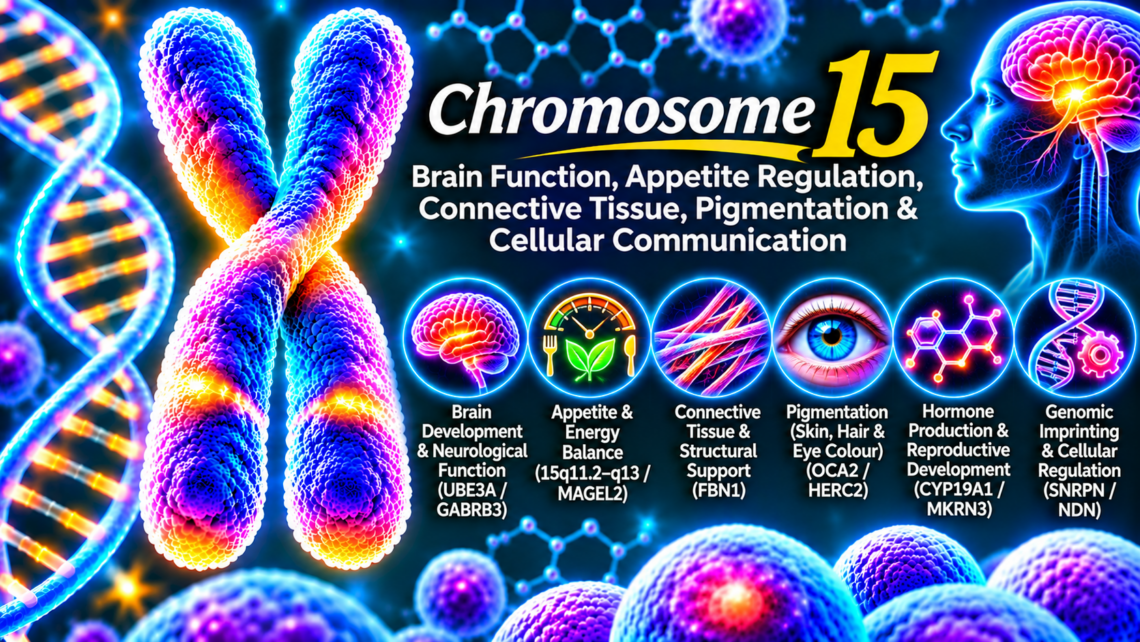
Chromosome 15 – The Genetic Blueprint of Brain Function, Appetite Regulation, Connective Tissue, Pigmentation & Cellular Communication
Exploring the genes, biological functions and fascinating parent-of-origin effects associated with Human Chromosome 15.
Introduction: Why Is Chromosome 15 So Interesting?
Human DNA contains 23 pairs of chromosomes, with one chromosome in each pair inherited from each biological parent. These chromosomes carry the genetic instructions that help guide our development, biological functions and individual characteristics.
Among them, Chromosome 15 is particularly fascinating because it contains genes involved in neurological development, appetite regulation, connective tissue formation, pigmentation, hormone production and cellular communication.
It is also home to one of the best-known examples of a genetic phenomenon called genomic imprinting. This is where certain genes behave differently depending on whether they are inherited from the mother or the father.
Chromosome 15 is therefore important not only for understanding our genetic blueprint, but also for exploring how genes, epigenetic regulation and biological development interact.
In this article, we explore the structure of Chromosome 15, its important genes, associated genetic conditions, and its broader significance for human wellbeing.
1. Understanding Chromosome 15
Chromosome 15 is one of the 22 pairs of autosomes found in human cells.
It contains approximately 102 million DNA building blocks, known as base pairs, and represents more than 3% of the DNA in a typical human cell.
Researchers estimate that Chromosome 15 contains approximately 630 protein-coding genes, although gene annotations continue to develop as genetic research advances.
Like other chromosomes, it consists of two arms:
- Short arm (p): The smaller arm.
- Long arm (q): The larger arm.
Several important genes are located along the long arm, including genes involved in brain development, connective tissue structure, pigmentation and hormone production.
One particularly important region is 15q11.2–q13, which contains genes associated with Prader-Willi syndrome and Angelman syndrome.
2. The Major Biological Functions of Chromosome 15
Chromosome 15 contributes to several important biological processes.
A. Brain Development and Neurological Function
Several genes on Chromosome 15 participate in the development and functioning of the nervous system.
The UBE3A gene is particularly important because it helps regulate the breakdown of proteins within cells. Its activity in certain neurons is influenced by genomic imprinting.
Other genes in the 15q11.2–q13 region contribute to neuronal development, cellular communication and the regulation of neurological processes.
Genes such as GABRB3 also contribute to the function of GABA receptors, which are involved in regulating communication between nerve cells.
B. Appetite Regulation and Energy Balance
One of Chromosome 15’s most interesting connections is its involvement in appetite and metabolic regulation.
The hypothalamus is a brain region responsible for coordinating several essential functions, including:
- Hunger and satiety.
- Energy balance.
- Body temperature.
- Hormonal regulation.
- Sleep-wake rhythms.
- Reproductive functions.
Genes within the imprinted 15q11.2–q13 region are associated with neurological pathways that influence some of these processes.
Disruption of this region can contribute to Prader-Willi syndrome, which is associated with characteristic changes in appetite regulation, body composition, growth and hormonal function.
This illustrates how genetic regulation in the brain can influence processes throughout the body.
C. Connective Tissue and Structural Support
The FBN1 gene on Chromosome 15 provides instructions for producing fibrillin-1, an important protein in connective tissue.
Fibrillin-1 helps form microfibrils, which contribute to the structure and organisation of connective tissues.
These structures are found in areas such as:
- Blood vessel walls.
- Ligaments and tendons.
- Skin.
- Bones.
- The eye.
- Other connective tissues.
FBN1 is especially significant because certain pathogenic variants are associated with Marfan syndrome, a genetic connective tissue disorder.
D. Skin, Hair and Eye Pigmentation
Chromosome 15 contains genes involved in determining pigmentation.
Two particularly important examples are:
- OCA2: Helps regulate melanin production and pigmentation.
- HERC2: Contains regulatory DNA sequences that influence OCA2 expression.
Melanin is the pigment responsible for much of the colour variation in human skin, hair and eyes.
Genetic variation in this region contributes to natural differences in pigmentation between individuals.
Certain changes affecting OCA2 can also cause forms of oculocutaneous albinism.
E. Hormone Production and Reproductive Development
Chromosome 15 contains the CYP19A1 gene, which provides instructions for producing the enzyme aromatase.
Aromatase converts certain androgens into oestrogens and plays an important role in hormone production.
It is active in several tissues, including the ovaries, testes, placenta, adipose tissue and brain.
Chromosome 15 also contains genes in the imprinted region that contribute to growth, puberty and reproductive development.
F. Cellular Communication and Regulation
Genes on Chromosome 15 participate in several processes that help cells function and communicate.
For example:
- GABRB3 contributes to GABA receptor function.
- UBE3A contributes to protein regulation.
- SNRPN is involved in RNA processing and regulation.
- NDN contributes to cellular and neurological development.
- HERC2 participates in protein regulation and cellular processes.
Together, these genes demonstrate how Chromosome 15 contributes to the complex coordination of cellular activity.
3. Important Genes Located on Chromosome 15
The following genes are particularly interesting because of their established roles in human biology.
| Gene | Primary function | Biological significance |
|---|---|---|
| UBE3A | Protein regulation | Nervous system function |
| SNRPN | RNA processing and regulation | Genomic imprinting |
| MKRN3 | Protein regulation | Puberty timing |
| MAGEL2 | Cellular regulation | Hypothalamic and developmental function |
| NDN | Cellular and neuronal development | Nervous system |
| GABRB3 | GABA receptor subunit | Neuronal communication |
| OCA2 | Pigmentation regulation | Skin, hair and eye colour |
| HERC2 | Protein regulation and OCA2 regulation | Pigmentation and cellular function |
| FBN1 | Fibrillin-1 production | Connective tissue structure |
| HEXA | Enzyme production | GM2 ganglioside metabolism |
| CYP19A1 | Aromatase production | Oestrogen synthesis |
| SLC24A5 | Ion exchange and pigmentation | Skin pigmentation |
UBE3A – Protein Regulation and Brain Function
The UBE3A gene provides instructions for producing an enzyme called ubiquitin protein ligase E3A.
This enzyme helps mark selected proteins for degradation, allowing cells to regulate protein levels and remove proteins that are no longer needed.
UBE3A is especially important in the nervous system.
In many tissues, both inherited copies can contribute to gene expression. However, in certain neurons, the paternal copy is largely silenced, making the maternally inherited copy particularly important.
Loss of functional maternal UBE3A activity in relevant brain regions is associated with Angelman syndrome.
SNRPN – RNA Processing and Genomic Imprinting
SNRPN is located within the imprinted region of Chromosome 15.
It contributes to the production of proteins involved in RNA processing and is part of a complex genomic region that regulates the expression of several nearby genes.
SNRPN is also closely associated with the imprinting control mechanisms involved in Prader-Willi and Angelman syndromes.
Its importance extends beyond one individual gene because the surrounding regulatory region helps coordinate the activity of several genes.
MKRN3 – The Timing of Puberty
The MKRN3 gene provides instructions for producing a protein involved in regulating biological processes associated with puberty.
It is normally expressed from the paternal copy in relevant tissues.
Certain pathogenic variants affecting the paternal MKRN3 copy can cause central precocious puberty, a condition in which puberty begins earlier than expected.
This makes MKRN3 an important example of how genomic imprinting can influence hormonal development.
MAGEL2 – Development and Hypothalamic Function
MAGEL2 is another paternally expressed gene within the 15q11.2–q13 region.
It contributes to cellular processes involved in protein regulation and is particularly relevant to neurological and hypothalamic development.
Certain pathogenic variants in MAGEL2 are associated with Schaaf-Yang syndrome, a rare neurodevelopmental condition.
GABRB3 – Communication Between Nerve Cells
GABRB3 provides instructions for producing the beta-3 subunit of the GABA-A receptor.
GABA, or gamma-aminobutyric acid, is one of the major inhibitory neurotransmitters in the nervous system.
GABA-A receptors help regulate neuronal activity by responding to GABA and allowing chloride ions to move across the cell membrane.
This contributes to the balance between excitatory and inhibitory signalling in the brain.
OCA2 and HERC2 – The Genetics of Pigmentation
OCA2 is involved in melanin production and the regulation of pigmentation.
The HERC2 gene contains regulatory elements that influence OCA2 activity.
Variations in this region are particularly well known for their contribution to natural human eye-colour differences.
Certain pathogenic changes affecting OCA2 can cause oculocutaneous albinism type 2.
FBN1 – Connective Tissue Structure
FBN1 produces fibrillin-1, a structural protein that contributes to the formation of connective tissue microfibrils.
These structures help support the organisation and elasticity of various tissues.
Pathogenic variants in FBN1 are associated with Marfan syndrome, which can affect the cardiovascular system, skeleton and eyes.
HEXA – Cellular Waste Processing
HEXA provides instructions for producing the alpha subunit of the enzyme beta-hexosaminidase A.
This enzyme helps break down GM2 ganglioside, a fatty substance found in cell membranes, particularly in nervous tissue.
When HEXA function is severely impaired, GM2 ganglioside can accumulate in cells, particularly neurons.
Certain pathogenic variants in HEXA cause Tay-Sachs disease.
CYP19A1 – Oestrogen Production
CYP19A1 produces aromatase, an enzyme responsible for converting androgens into oestrogens.
Oestrogens are important for reproductive development, bone health and several other biological processes.
The activity of aromatase varies between tissues and across different stages of life.
SLC24A5 – Skin Pigmentation
SLC24A5 provides instructions for producing a protein involved in ion exchange within cells.
Genetic variation in this gene contributes to differences in human skin pigmentation.
It is one of several genes involved in the complex biological processes that influence melanin production and distribution.
4. Genomic Imprinting: When the Parent of Origin Matters
One of the most remarkable features of Chromosome 15 is the presence of an imprinted region.
Genomic imprinting is an epigenetic process in which certain genes are expressed differently depending on whether they were inherited from the mother or father.
Most genes have two copies, and both copies can contribute to gene expression.
However, for imprinted genes, one parental copy may be naturally silenced or expressed at a much lower level.
This is usually regulated through epigenetic mechanisms such as DNA methylation and chromatin organisation.
The 15q11.2–q13 region contains several genes with parent-of-origin-dependent expression.
For example:
- Several genes associated with Prader-Willi syndrome are normally expressed from the paternal chromosome.
- UBE3A is preferentially expressed from the maternal chromosome in certain neurons.
This creates a fascinating biological situation in which the parental origin of a chromosome can influence how particular genes function.
Why Is This Important?
Genomic imprinting demonstrates that genetic information is not simply about which genes are present.
It is also about how those genes are regulated.
Two people may inherit genetic material containing the same genes, but the expression of particular genes can differ depending on parental origin and epigenetic regulation.
Chromosome 15 is one of the clearest examples of this principle.
5. Genetic Conditions Associated With Chromosome 15
Changes affecting Chromosome 15 can be associated with several genetic conditions.
These may result from changes in individual genes, deletions or duplications of chromosome regions, or abnormalities in genomic imprinting.
Prader-Willi Syndrome
Prader-Willi syndrome is associated with the loss of normal expression of certain paternally expressed genes in the 15q11.2–q13 region.
Possible genetic mechanisms include:
- Deletion of the relevant region on the paternal chromosome.
- Maternal uniparental disomy, where both copies of Chromosome 15 are inherited from the mother.
- An imprinting defect that prevents the paternal genes from being expressed normally.
Features can include:
- Infant feeding difficulties.
- Low muscle tone during infancy.
- Developmental delays.
- Changes in appetite regulation.
- Excessive hunger in later childhood.
- Hormonal and reproductive differences.
- Behavioural and learning challenges.
Prader-Willi syndrome demonstrates the importance of genes involved in hypothalamic function, growth and appetite regulation.
Angelman Syndrome
Angelman syndrome is a neurological condition associated with reduced or absent UBE3A activity in relevant parts of the brain.
It can result from several genetic mechanisms, including:
- Deletion of the maternally inherited 15q11.2–q13 region.
- Pathogenic variants affecting UBE3A.
- Paternal uniparental disomy.
- Imprinting defects.
Features can include:
- Developmental delay.
- Severe speech impairment.
- Movement and balance difficulties.
- Seizures.
- Sleep disturbances.
- A characteristic behavioural and neurological profile.
Although Prader-Willi and Angelman syndromes involve the same broad chromosomal region, they arise through different patterns of gene expression.
Marfan Syndrome
Marfan syndrome is associated with pathogenic variants in FBN1.
It is a connective tissue disorder that can affect several body systems.
Possible features include:
- Long limbs and fingers.
- Joint hypermobility.
- Skeletal differences.
- Eye complications.
- Enlargement of the aorta.
- Cardiovascular complications.
Because the cardiovascular system can be affected, proper medical assessment and monitoring are important.
Tay-Sachs Disease
Tay-Sachs disease is associated with pathogenic variants in HEXA that significantly reduce beta-hexosaminidase A activity.
This results in the accumulation of GM2 ganglioside, particularly in nerve cells.
The condition can cause progressive neurological deterioration.
Different forms of Tay-Sachs disease can begin during infancy, childhood or adulthood.
Oculocutaneous Albinism Type 2
Certain pathogenic variants in OCA2 can cause oculocutaneous albinism type 2.
This condition affects melanin production and can influence:
- Skin pigmentation.
- Hair pigmentation.
- Eye pigmentation.
- Visual development.
The degree of pigmentation varies between individuals.
Schaaf-Yang Syndrome
Schaaf-Yang syndrome is associated with pathogenic variants in the paternally inherited MAGEL2 gene.
It is a rare neurodevelopmental condition that can involve:
- Developmental delay.
- Low muscle tone.
- Feeding difficulties.
- Joint contractures.
- Differences in growth and development.
15q11.2–q13 Duplication Syndrome
Duplication of the 15q11.2–q13 region can result in additional copies of genes within this area.
The clinical effects can vary depending on the genetic structure and whether the duplicated material is inherited from the mother or father.
Maternal duplications are particularly associated with a neurodevelopmental condition known as dup15q syndrome.
Possible features include developmental delays, intellectual disability, epilepsy and differences in communication and behaviour.
Other Chromosome 15 Abnormalities
Other structural changes can affect Chromosome 15, including:
- 15q deletion syndromes.
- 15q duplication syndromes.
- Ring chromosome 15.
- Uniparental disomy.
- Other rare chromosomal rearrangements.
The effects depend on which genes and regulatory regions are affected.
6. Chromosome 15 and the Body Systems
The genes located on Chromosome 15 contribute to several interconnected biological systems.
| Body system | Relevant genes | Biological connection |
|---|---|---|
| Nervous system | UBE3A, GABRB3, MAGEL2, NDN | Neuronal development and communication |
| Endocrine system | MKRN3, CYP19A1 | Puberty and hormone production |
| Metabolic regulation | MAGEL2 and imprinted-region genes | Appetite and energy-related pathways |
| Connective tissue | FBN1 | Structural support and elasticity |
| Integumentary system | OCA2, HERC2, SLC24A5 | Pigmentation |
| Cellular metabolism | HEXA | Breakdown of GM2 ganglioside |
| Reproductive system | CYP19A1, MKRN3 | Hormonal and reproductive development |
These connections illustrate that chromosomes do not operate in isolation.
Biological systems rely on networks of genes, proteins, hormones, signalling molecules and environmental influences.
7. Chromosome 15, Epigenetics and Gene Expression
Epigenetics refers to processes that influence how genes are used without changing the underlying DNA sequence.
Chromosome 15 is especially relevant to epigenetic research because of its imprinted 15q11.2–q13 region.
Two important mechanisms include:
DNA methylation: Chemical groups called methyl groups can attach to DNA and influence whether certain genes are expressed.
Chromatin organisation: DNA is packaged around proteins called histones. Changes in this structure can influence how accessible particular genes are to the cellular machinery responsible for reading them.
These processes help regulate gene activity during development and throughout life.
Importantly, epigenetic regulation is complex. It is not accurate to assume that a particular lifestyle practice can directly activate or deactivate a specific Chromosome 15 gene.
Sleep, nutrition, movement and environmental exposures can influence broader biological processes, but their effects should not be confused with reversing an inherited genetic condition or correcting an imprinting defect.
8. A Holistic Wellbeing Perspective
At VitalPulse, we explore wellbeing through the interaction of physical, emotional, mental and lifestyle factors.
Chromosome 15 provides an interesting opportunity to reflect on the relationship between inherited biological characteristics and the systems that help maintain everyday wellbeing.
The following connections are intended as educational perspectives, not medical interpretations of an individual’s genes.
Brain and Nervous System Wellbeing
Chromosome 15 contains genes involved in neuronal communication, protein regulation and neurological development.
General wellbeing practices that support nervous system health include:
- Maintaining consistent sleep routines.
- Engaging in regular physical activity.
- Eating a balanced and varied diet.
- Allowing time for relaxation and recovery.
- Maintaining meaningful social connections.
- Seeking appropriate support for neurological or developmental concerns.
Hormonal and Metabolic Wellbeing
The hypothalamus and endocrine system work together to regulate appetite, energy balance, reproductive hormones and other essential functions.
Supporting general metabolic wellbeing involves:
- Eating regular, balanced meals.
- Maintaining adequate hydration.
- Getting sufficient sleep.
- Engaging in sustainable movement.
- Managing stress where possible.
- Seeking professional assessment when hormonal symptoms arise.
Connective Tissue and Structural Wellbeing
FBN1 illustrates the importance of connective tissue in maintaining the structure of the body.
General musculoskeletal wellbeing can be supported through appropriate movement, resistance exercise, balanced nutrition and recovery.
However, inherited connective tissue disorders such as Marfan syndrome require proper medical assessment and ongoing care.
Skin and Eye Wellbeing
Genes such as OCA2 and HERC2 help explain natural differences in pigmentation.
Protecting skin and eye health includes sensible sun protection, appropriate eye care and professional assessment of changes in vision or skin.
Cellular Wellbeing
HEXA demonstrates how important cellular waste-processing systems are for maintaining normal cell function.
Cells constantly produce, process, recycle and remove biological materials.
Adequate nutrition, sleep and general health support normal cellular function, although they cannot correct inherited enzyme deficiencies such as those associated with Tay-Sachs disease.
9. Chromosome 15 and Tarot: A Symbolic Perspective
In Tarot, the number XV corresponds to The Devil card in the Major Arcana.
The Devil is traditionally associated with attachment, desire, instinct, material influences, limitation and the patterns that can keep us feeling bound to familiar behaviours.
There is no established scientific relationship between Chromosome 15 and Tarot. The following interpretation is an esoteric reflection inspired by the biological themes explored in this article.
The Devil XV – Instinct, Appetite and Attachment
Chromosome 15 contains genes associated with appetite regulation, hormonal development, neurological function and other processes connected with our biological needs.
The Devil card can symbolically invite us to explore the relationship between instinct and conscious choice.
It raises questions about the patterns that influence our behaviour:
- What drives our habits?
- How do we respond to desire and immediate gratification?
- Which patterns support us, and which may limit us?
- How can awareness help us develop healthier relationships with our needs?
The Empress III – Growth and the Physical Body
The Empress represents nurturing, fertility, embodiment, growth and the natural world.
This symbolism can be connected metaphorically with Chromosome 15’s involvement in growth, reproductive development, hormonal processes and connective tissue.
It invites reflection on how we nurture the physical body and create conditions that support healthy development.
The High Priestess II – Hidden Information and Inheritance
The High Priestess represents hidden knowledge, intuition, mystery and what lies beneath the surface.
Genomic imprinting offers an interesting symbolic parallel: some of the information contained within our DNA is regulated in ways that are not immediately visible.
The High Priestess can therefore represent the unseen layers of biological regulation and inherited information.
The Devil and Personal Awareness
The symbolic connection between The Devil and Chromosome 15 is not about labelling genes or biological conditions as negative.
Instead, it offers an opportunity to reflect on the relationship between biological needs, learned habits, emotional patterns and conscious awareness.
The central question becomes:
How can we become more aware of the patterns that influence our lives without becoming defined by them?
10. Reflective Questions
Take a moment to consider the following questions:
- How do I respond to hunger, desire and other physical needs?
- Which daily habits support my physical and emotional wellbeing?
- Do I recognise patterns that repeatedly influence my behaviour?
- How well do I balance immediate needs with long-term wellbeing?
- What does nurturing my body mean to me?
- How can greater self-awareness help me make more conscious choices?
These questions are intended for personal reflection, not genetic or psychological assessment.
11. Frequently Asked Questions About Chromosome 15
What does Chromosome 15 do?
Chromosome 15 contains genes involved in neurological development, appetite regulation, connective tissue formation, pigmentation, hormone production and cellular processes.
Which genetic conditions are associated with Chromosome 15?
Some well-known conditions include Prader-Willi syndrome, Angelman syndrome, Marfan syndrome, Tay-Sachs disease, oculocutaneous albinism type 2, Schaaf-Yang syndrome and dup15q syndrome.
What is special about Chromosome 15 and genomic imprinting?
Certain genes in the 15q11.2–q13 region are expressed differently depending on whether they were inherited from the mother or father. This is known as genomic imprinting.
What is the difference between Prader-Willi syndrome and Angelman syndrome?
Both conditions involve the imprinted region of Chromosome 15, but they affect different patterns of gene expression.
Prader-Willi syndrome involves the loss of normal expression of certain paternally active genes. Angelman syndrome usually involves the loss of maternal UBE3A activity in relevant brain regions.
Does Chromosome 15 influence appetite?
Genes in the imprinted region of Chromosome 15 are associated with neurological and hypothalamic pathways involved in appetite regulation. Disruption of this region can contribute to the appetite-related features of Prader-Willi syndrome.
Is Marfan syndrome associated with Chromosome 15?
Yes. Marfan syndrome is commonly associated with pathogenic variants in the FBN1 gene, which is located on Chromosome 15.
Does Chromosome 15 influence eye colour?
Yes. The OCA2 and HERC2 region contributes to pigmentation differences, including natural variation in human eye colour.
Can lifestyle changes alter Chromosome 15?
Lifestyle changes do not rewrite the DNA sequence of Chromosome 15 or correct inherited genetic conditions. However, general lifestyle habits can support overall health and influence certain biological processes involved in gene regulation.
12. Conclusion: The Relationship Between Inheritance, Regulation and Wellbeing
Chromosome 15 is a fascinating part of the human genetic blueprint.
Its genes contribute to neurological development, appetite regulation, hormonal processes, connective tissue structure, pigmentation and cellular metabolism.
Perhaps its most remarkable feature is genomic imprinting, which demonstrates that gene activity can depend on the parent from whom genetic information was inherited.
Chromosome 15 reminds us that biology is not simply a collection of isolated genes. It is an interconnected network of inherited information, cellular processes, regulatory mechanisms and environmental influences.
From a holistic wellbeing perspective, understanding these connections encourages us to appreciate the complexity of the human body while recognising the importance of supporting our overall health.
At VitalPulse, we believe that wellbeing begins with curiosity, awareness and a willingness to explore the many factors that influence how we live.
Explore Your Wellbeing. Reconnect. Reflect. Realign.
Curious About NLS Bioresonance Scanning?
What if you could explore your body’s energetic patterns from a different perspective?
At VitalPulse, we invite you to discover NLS (Non-Linear System) Bioresonance Scanning – an alternative wellness exploration approach designed to provide insights into energetic patterns and potential areas of imbalance within the body’s systems.
Whether you’re interested in understanding your wellbeing more deeply, exploring the body’s interconnected systems, or simply curious about complementary approaches to wellness, an NLS scan offers an opportunity to explore a different perspective.
Why not experience it for yourself?
✨ Explore your body’s energetic patterns.
✨ Discover a different perspective on your overall wellbeing.
✨ Identify areas you may wish to explore further as part of your personal wellness journey.
🎁 Take the First Step – Explore NLS Bioresonance!
👉 EXPLORE NLS BIORESONANCE SCANNING
VitalPulse – Explore Your Wellbeing.
Reconnect. Reflect. Realign.
Please note: NLS Bioresonance scanning is offered as a complementary wellness exploration service. It is not a medically validated diagnostic tool and does not diagnose, treat, cure or prevent disease. It is not a substitute for professional medical advice, diagnosis or treatment.
References and Further Reading
The following resources provide additional scientific information about Chromosome 15 and its associated genes and conditions.
- MedlinePlus Genetics – Chromosome 15
https://medlineplus.gov/genetics/chromosome/15/ - GeneReviews – Prader-Willi Syndrome
https://www.ncbi.nlm.nih.gov/books/NBK1330/ - GeneReviews – Angelman Syndrome
https://www.ncbi.nlm.nih.gov/books/NBK1144/ - MedlinePlus Genetics – FBN1 Gene
https://medlineplus.gov/genetics/gene/fbn1/ - National Institute of Child Health and Human Development – Causes of Prader-Willi Syndrome
https://www.nichd.nih.gov/health/topics/prader-willi/conditioninfo/causes - Nicholls & Knepper – Genome Organization, Function, and Imprinting in Prader-Willi and Angelman Syndromes
Annual Review of Genomics and Human Genetics.
https://doi.org/10.1146/annurev.genom.2.1.153
Medical Disclaimer
This article is provided for general educational and wellbeing information only. It is not intended to diagnose, treat, cure or prevent any medical condition.
Genetic conditions require appropriate assessment by qualified healthcare professionals. The presence of a gene or genetic variant does not automatically mean that an individual will develop a particular condition.
The Tarot and holistic perspectives presented in this article are symbolic and reflective. They are not scientifically established explanations of chromosome function, genetic inheritance or disease.
VitalPulse promotes wellbeing education and personal exploration, not medical diagnosis.
VitalPulse – Explore Your Wellbeing. Reconnect. Reflect. Realign.


You May Also Like
Lactobacillus Acidophilus: Understanding Its Role in Gut Health, Digestion and Immune Function
The Hidden Secrets of Water: The Work of Dr. Masaru Emoto and the Connection Between Water, Consciousness, Bioresonance & Energy Healing