Chromosome Y: The Genetic Blueprint of Sex Development, Sperm Production, Hormone Signalling & Human Evolution
Exploring the genes, biological functions, genetic conditions and evolutionary significance of the human Y chromosome.
Introduction: Understanding the Y Chromosome
Chromosome Y is one of the two human sex chromosomes, alongside Chromosome X. It is most commonly associated with typical male sexual development, but its biological importance extends into several areas of human physiology and genetics.
The Y chromosome contains genes involved in testicular development, sperm production, hormone-related development and cellular regulation. It also contains genetic regions that are shared with Chromosome X, demonstrating that these two chromosomes have a more complex relationship than their different appearances might suggest.
One of its most important genes is SRY (Sex-determining Region Y), which plays a central role in initiating the developmental pathway that typically leads to testis formation.
Another fascinating feature is its evolutionary history. Over millions of years, the Y chromosome has changed considerably, becoming smaller than its ancestral chromosome and developing specialised genetic regions.
Understanding Chromosome Y offers insight into human development, reproductive biology, genetic inheritance and the evolution of our species.
1. Understanding Chromosome Y
Chromosome Y is the smaller of the two human sex chromosomes.
In the most common human sex chromosome patterns:
- 46,XX is associated with typical female sexual development.
- 46,XY is associated with typical male sexual development.
However, sex development is a complex biological process involving chromosomes, genes, hormones, receptors and developmental pathways. Variations in sex chromosome patterns and sex development also occur.
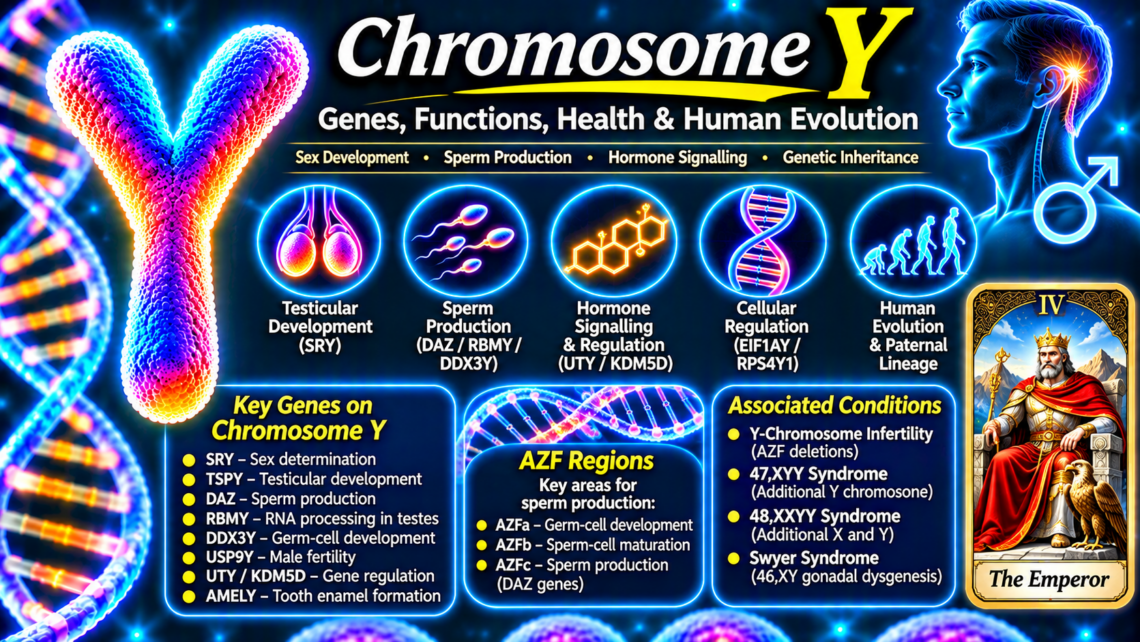
Some important characteristics of Chromosome Y include:
| Feature | Description |
|---|---|
| Chromosome type | Sex chromosome |
| Approximate length | 62 million DNA base pairs in the complete reference sequence |
| Percentage of cellular DNA | Approximately 2% |
| Protein-coding genes | Approximately 100 in the complete reference sequence, depending on annotation |
| Main biological roles | Testicular development, sperm production and sex-related development |
| Main regions | Short arm (Yp), centromere and long arm (Yq) |
| Special features | Repetitive DNA, palindromic sequences and pseudoautosomal regions |
Gene counts differ between reference assemblies and annotation methods.
The 2023 Telomere-to-Telomere (T2T) consortium study produced a complete sequence of a human Y chromosome containing 62,460,029 base pairs. This filled in more than 30 million base pairs missing from the earlier reference assembly and revealed additional copies of genes, particularly within the TSPY family.
This was a major achievement because the Y chromosome’s repetitive structure had made it particularly difficult to sequence accurately.
2. The SRY Gene: The Initiator of Typical Testicular Development
One of the most important genes on Chromosome Y is SRY, short for Sex-determining Region Y.
SRY is located on the short arm of the Y chromosome and provides instructions for producing a protein called the sex-determining region Y protein.
This protein acts as a transcription factor, meaning it helps regulate the activity of other genes.
How does SRY work?
During early embryonic development, the developing gonads initially have the potential to follow different developmental pathways.
In embryos where SRY is expressed at the appropriate time and level, it helps activate a developmental programme that promotes testicular differentiation.
One of its important targets is the SOX9 gene, which plays a central role in testis development.
The process can be summarised as follows:
- SRY is expressed in supporting cells of the developing gonad.
- SRY helps activate SOX9.
- SOX9 contributes to the development of testicular supporting cells.
- The developing testes produce hormones that influence further sexual development.
- These hormonal signals contribute to the development of reproductive structures and secondary sex characteristics.
It is important to understand that SRY does not independently determine every aspect of sex development. Many genes, hormones and developmental processes work together.
What happens when SRY is altered?
Changes involving SRY can affect typical sex development.
For example, certain SRY variants can result in 46,XY complete gonadal dysgenesis, commonly known as Swyer syndrome.
In other circumstances, SRY can be transferred to another chromosome, including Chromosome X, during the formation of reproductive cells.
This can result in an individual with a 46,XX chromosome pattern developing testicular tissue.
These examples demonstrate that sex development involves complex genetic interactions rather than a single chromosome acting in isolation.
3. Important Genes Located on Chromosome Y
Although Chromosome Y contains fewer protein-coding genes than Chromosome X, several of its genes are essential for reproductive development and cellular regulation.
| Gene | Main function | Biological significance |
|---|---|---|
| SRY | Regulates sex-determining pathways | Initiation of typical testicular development |
| TSPY | Testis-specific protein family | Testicular development and germ-cell biology |
| DAZ1 / DAZ2 | RNA-binding proteins | Sperm production |
| RBMY | RNA-binding protein | Regulation of RNA processing in the testis |
| DDX3Y | RNA helicase | Germ-cell development and spermatogenesis |
| USP9Y | Protein deubiquitination | Male fertility and sperm production |
| ZFY | Transcription factor | Developmental gene regulation |
| UTY | Histone demethylase-related protein | Chromatin regulation |
| KDM5D | Histone demethylase | Epigenetic regulation |
| EIF1AY | Translation initiation factor | Protein synthesis |
| RPS4Y1 | Ribosomal protein | Cellular protein production |
| AMELY | Amelogenin protein | Enamel formation |
| TBL1Y | Transcriptional regulation | Cellular gene regulation |
Some of these genes belong to families with related copies on the X chromosome. Others are found in specialised regions of the Y chromosome.
SRY – Sex-Determining Region Y
SRY initiates a developmental pathway that promotes testicular differentiation.
It acts as a transcription factor and helps activate other genes involved in the formation of testicular tissue.
SRY is one of the most extensively studied genes involved in mammalian sex development.
TSPY – Testis-Specific Protein Y-Linked
TSPY belongs to a gene family with multiple copies on Chromosome Y.
It is expressed in testicular tissue and has been studied for its involvement in germ-cell development and cell proliferation.
Its exact biological roles are still being investigated, and its presence should not be interpreted as a direct measure of fertility.
DAZ – Deleted in Azoospermia
The DAZ gene family is located in the AZFc region of the Y chromosome.
These genes produce RNA-binding proteins involved in the development of germ cells.
Germ cells are the specialised cells that ultimately develop into sperm.
Deletions affecting DAZ gene copies can contribute to impaired sperm production and male infertility.
RBMY – RNA-Binding Motif Protein Y-Linked
RBMY produces RNA-binding proteins that contribute to RNA processing.
RNA processing is essential because cells must correctly prepare genetic instructions before they can be used to produce proteins.
RBMY is expressed predominantly in testicular tissue and is associated with normal sperm development.
DDX3Y – RNA Helicase
DDX3Y produces a protein involved in RNA metabolism and cellular processes.
It belongs to a family of RNA helicases, enzymes that help unwind RNA molecules and regulate aspects of RNA processing and translation.
DDX3Y is important in male germ-cell development, and alterations or deletions involving this gene can contribute to impaired sperm production.
USP9Y – Ubiquitin-Specific Peptidase 9 Y-Linked
USP9Y produces an enzyme involved in removing ubiquitin molecules from proteins.
Ubiquitination is a cellular process that helps regulate protein activity, stability and breakdown.
USP9Y has been associated with male fertility, although its contribution varies depending on the genetic change involved.
ZFY – Zinc Finger Protein Y-Linked
ZFY produces a transcription factor containing zinc-finger DNA-binding domains.
Transcription factors help regulate which genes are active in particular cells.
ZFY is involved in developmental and reproductive biology, although its full range of functions is still being investigated.
UTY – Ubiquitously Transcribed Tetratricopeptide Repeat Containing Y-Linked
UTY produces a protein involved in chromatin regulation.
Chromatin is the combination of DNA and proteins that organises genetic material inside the nucleus.
UTY is related to the X-linked UTX gene, also known as KDM6A.
These genes are involved in regulating histone modifications, which influence how DNA is organised and how genes are expressed.
KDM5D – Lysine Demethylase 5D
KDM5D is another gene involved in epigenetic regulation.
It produces an enzyme that removes certain methyl groups from histone proteins.
Histones help package DNA into chromatin, and their chemical modifications influence gene activity.
KDM5D therefore contributes to the complex mechanisms involved in regulating cellular gene expression.
EIF1AY and RPS4Y1 – Protein Production
EIF1AY and RPS4Y1 are involved in fundamental cellular processes.
EIF1AY contributes to the initiation of protein translation, while RPS4Y1 encodes a ribosomal protein.
Ribosomes are the cellular structures responsible for assembling proteins using instructions carried by messenger RNA.
These genes illustrate that the Y chromosome is involved in more than reproductive development.
AMELY – Amelogenin Y-Linked
AMELY is located in the pseudoautosomal boundary region of the Y chromosome.
It produces amelogenin, a protein involved in tooth enamel formation.
AMELY has a related gene, AMELX, on Chromosome X.
Genetic differences between AMELY and AMELX can also be useful in certain forensic and genetic identification applications.
4. The AZF Regions: The Genetic Architecture of Sperm Production
One of the most important functional areas of Chromosome Y is the AZF region, short for Azoospermia Factor.
These regions contain genes involved in sperm production and the development of male germ cells.
Deletions affecting these regions can cause severe problems with sperm production.
The AZF region is divided into three major sections:
- AZFa
- AZFb
- AZFc
AZFa
AZFa contains genes including USP9Y and DDX3Y.
Large deletions affecting AZFa can result in severe impairment of sperm production, sometimes with an absence of sperm-producing cells in the testes.
AZFb
AZFb contains several genes involved in germ-cell development and RNA processing, including RBMY family members.
Deletions in this region can disrupt sperm-cell development at particular stages.
AZFc
AZFc contains several genes and gene families associated with spermatogenesis, including DAZ and BPY2.
Deletions in AZFc are among the more frequently identified Y-chromosome microdeletions in men being investigated for severe sperm-production problems.
The effects vary, and some individuals with AZFc deletions retain limited sperm production.
Why are AZF deletions important?
Y-chromosome microdeletions are an established genetic cause of male infertility.
They can be identified through specialised genetic testing and may influence fertility treatment decisions.
This is one reason genetic assessment can be valuable when investigating severe oligospermia or azoospermia.
5. Y-Chromosome Inheritance: The Father-to-Son Pathway
The Y chromosome has a distinctive inheritance pattern.
In typical XY reproduction, an egg contributes an X chromosome, while a sperm contributes either an X or a Y chromosome.
When a sperm carrying a Y chromosome fertilises an egg, the resulting embryo typically has an XY chromosome pattern.
Because the Y chromosome is usually passed from father to son, most Y-linked genetic variants follow a father-to-son inheritance pattern.
Understanding Y-linked inheritance
A genetic variant located in a region unique to the Y chromosome can be passed from a father to his sons.
A father does not pass his Y chromosome to daughters in the typical inheritance pattern.
This makes Y-linked inheritance different from X-linked inheritance.
However, the pseudoautosomal regions of the X and Y chromosomes can exchange genetic material during meiosis. These regions contain genes shared by both sex chromosomes and can follow different inheritance patterns.
What does this mean for family genetics?
Y-chromosome analysis can sometimes help researchers investigate paternal ancestry and certain inherited genetic variants.
However, not every genetic characteristic associated with male development is inherited exclusively through the Y chromosome.
Many important reproductive and developmental genes are located on other chromosomes, including Chromosome X and the autosomes.
6. Genetic Conditions Associated with Chromosome Y
Changes involving Chromosome Y can affect sex development, sperm production and chromosome number.
Some changes involve individual genes, while others affect larger chromosome regions.
Y-Chromosome Infertility
Y-chromosome infertility is associated with deletions in regions containing genes required for normal sperm production.
These deletions most commonly involve the AZF regions.
Possible effects include:
- Azoospermia, meaning no sperm are detected in the semen.
- Severe oligospermia, meaning a very low sperm count.
- Impaired sperm development.
- Reduced chances of natural conception.
The severity depends on which region is affected.
47,XYY Syndrome
47,XYY syndrome occurs when an individual has an additional Y chromosome.
Instead of the typical 46,XY pattern, cells contain 47 chromosomes.
Possible features include:
- Taller-than-average stature
- Speech and language delays
- Learning difficulties
- Motor coordination differences
- Attention-related difficulties
- Emotional or behavioural challenges in some individuals
Many individuals have mild features or may not know they have the condition.
XYY syndrome does not automatically cause infertility or aggressive behaviour. These are misconceptions that should be avoided.
48,XXYY Syndrome
48,XXYY syndrome involves an additional X chromosome and an additional Y chromosome.
It is associated with a combination of developmental, hormonal, reproductive and physical features.
Possible characteristics include:
- Reduced testosterone production
- Small testes
- Infertility
- Developmental delays
- Speech and language difficulties
- Learning challenges
- Certain skeletal or dental differences
The presentation varies between individuals.
46,XY Complete Gonadal Dysgenesis (Swyer Syndrome)
Swyer syndrome is a difference of sex development in which an individual has an XY chromosome pattern but the gonads do not develop into functioning testes.
This can result from changes involving SRY or other genes in the sex-development pathway.
Possible features include:
- Female-typical external genital development
- Underdeveloped or non-functioning gonadal tissue
- Delayed puberty without hormone treatment
- Reduced production of sex hormones
- Infertility without specialised reproductive intervention
The condition demonstrates that an XY chromosome pattern alone does not guarantee typical testicular development.
46,XX Testicular Difference of Sex Development
Some individuals with a 46,XX chromosome pattern develop testicular tissue.
In many cases, this occurs because the SRY gene has been transferred from the Y chromosome to another chromosome, usually the X chromosome.
This can initiate testicular development despite the absence of a complete Y chromosome.
However, other genetic and developmental pathways can also be involved in 46,XX differences of sex development.
Other Y-Chromosome Variations
Additional structural and numerical changes involving Chromosome Y can occur.
Examples include:
- Mosaic 46,XY/47,XYY patterns
- Structural rearrangements
- Partial deletions
- Rare forms of Y-chromosome polysomy
The effects depend on the precise chromosome change and the tissues in which it is present.
7. Chromosome Y and the Development of Male Characteristics
The Y chromosome contributes to typical male sexual development through a sequence of genetic and hormonal processes.
However, it is important to distinguish between chromosome-based sex determination, gonadal development, hormone production and the body’s response to hormones.
These processes are related but not identical.
Testicular Development
SRY helps initiate the development of testes.
The developing testes contain specialised cells that produce hormones involved in further sexual development.
Testosterone Production
Leydig cells in the testes produce testosterone.
Testosterone contributes to the development and maintenance of several biological characteristics, including:
- Development of male reproductive structures
- Muscle and bone physiology
- Secondary sex characteristics
- Sexual function
- Certain aspects of metabolic regulation
Testosterone production is regulated through interactions between the hypothalamus, pituitary gland and testes.
Sertoli Cells and Sperm Development
Sertoli cells support developing sperm cells within the seminiferous tubules of the testes.
They respond to hormonal signals and provide the environment required for spermatogenesis.
The development of functional sperm depends on many genes, including genes located on Chromosome Y.
Hormonal Feedback
The reproductive endocrine system operates through feedback mechanisms.
The hypothalamus releases gonadotropin-releasing hormone (GnRH), which stimulates the pituitary gland to release:
- Luteinising hormone (LH)
- Follicle-stimulating hormone (FSH)
LH stimulates testosterone production by Leydig cells, while FSH works with testosterone to support Sertoli-cell function and sperm development.
Chromosome Y contributes to the developmental foundation of the reproductive system, but it does not independently regulate every aspect of hormonal health.
8. Chromosome Y and Evolution
The Y chromosome has a fascinating evolutionary history.
Millions of years ago, the ancestors of the human X and Y chromosomes were an ordinary pair of chromosomes, known as autosomes.
Over evolutionary time, one member of this pair acquired the SRY gene and became associated with sex determination.
As the chromosomes evolved, large sections gradually stopped exchanging genetic material.
This process is known as suppression of recombination.
Why did the Y chromosome become smaller?
When two chromosomes exchange genetic material, recombination helps maintain genetic diversity and can assist in removing harmful mutations.
Most of the Y chromosome no longer recombines with the X chromosome.
Over evolutionary time, this contributed to the loss or alteration of many ancestral genes.
The modern Y chromosome is therefore much smaller than its X-chromosome counterpart.
However, the Y chromosome has not simply become a useless genetic remnant. It has retained important genes involved in reproduction and cellular function.
Palindromic DNA Sequences
One unusual feature of Chromosome Y is the presence of large palindromic DNA sequences.
These are regions in which DNA sequences are arranged in an inverted pattern, creating similarities when read in opposite directions.
These structures are particularly important in the Y chromosome’s ampliconic regions, where certain genes occur in multiple copies.
They may also contribute to structural rearrangements through processes such as gene conversion.
The Complete Y-Chromosome Sequence
In August 2023, the Telomere-to-Telomere consortium published a complete sequence of a human Y chromosome.
This was a major scientific milestone because the repetitive structure of the Y chromosome had previously made it difficult to assemble accurately.
The completed sequence provided new information about:
- The TSPY gene family
- DAZ gene copies
- RBMY gene copies
- Repetitive DNA sequences
- Chromosome structure
- Regions associated with sperm production
This improved reference sequence gives researchers a better foundation for studying human genetics, reproductive biology and chromosome evolution.
9. Chromosome Y and Epigenetics
Epigenetics explores how gene activity can be influenced without changing the underlying DNA sequence.
Chromosome Y contains genes involved in epigenetic regulation, including UTY and KDM5D.
These genes contribute to processes involving histone proteins and chromatin organisation.
What are histones?
Histones are proteins around which DNA is organised.
They help package the genome into a compact structure inside the nucleus.
Chemical modifications to histones can influence how accessible certain regions of DNA are to the cellular machinery responsible for gene expression.
UTY and KDM5D
UTY and KDM5D are related to genes located on Chromosome X.
They are involved in chromatin-related processes and can influence gene regulation.
Their functions demonstrate that the Y chromosome contributes to cellular regulation beyond its well-known reproductive roles.
Why is this important?
Epigenetic regulation is part of the body’s system for controlling how genetic instructions are used.
It helps cells maintain specialised functions, respond to developmental signals and organise biological processes.
However, it is important not to assume that general lifestyle changes can specifically alter UTY or KDM5D activity in a predictable way.
10. The Y Chromosome Beyond Reproduction: The X-Y Relationship
Although Chromosomes X and Y have different sizes and gene content, they share an important evolutionary relationship.
The two chromosomes retain small regions known as pseudoautosomal regions (PARs).
These regions contain genes that are present on both chromosomes and can exchange genetic material during meiosis.
What are pseudoautosomal regions?
There are two main pseudoautosomal regions:
- PAR1, located near the ends of the short arms.
- PAR2, located near the ends of the long arms.
Genes in these regions are not inherited in the same way as genes found exclusively on the Y chromosome.
They also escape the usual X-chromosome inactivation process.
The SHOX Gene
One important gene found in PAR1 is SHOX.
SHOX contributes to normal skeletal development and growth.
Because it is present in both X and Y chromosomes, individuals typically have two functional copies.
Changes in SHOX dosage can contribute to certain growth and skeletal conditions.
This is an example of how the X and Y chromosomes continue to work together in important biological processes.
11. Chromosome Y and Age-Related Loss of the Y Chromosome
An interesting area of modern genetics involves a phenomenon called mosaic loss of Y (mLOY).
This occurs when some cells in an individual with a Y chromosome lose that chromosome during cell division.
The result is a mixture of cells, some containing the Y chromosome and others lacking it.
Mosaic loss of Y becomes more common with age and has been studied in relation to smoking, blood-cell ageing and certain disease risks.
Researchers have also investigated associations between mLOY and cardiovascular disease, cancer and other health outcomes.
However, these relationships are complex. An association does not automatically prove that loss of the Y chromosome directly causes a particular disease.
Mosaic loss of Y is a phenomenon observed in certain cell populations, especially blood cells. It does not mean that the entire body suddenly loses its Y chromosome.
This research illustrates how chromosome biology continues to influence our understanding of ageing and cellular health.
12. A Holistic Wellbeing Perspective: Exploring the Functions of Chromosome Y
From a holistic wellbeing perspective, Chromosome Y offers an opportunity to explore reproductive health, hormonal balance, cellular regulation and the broader relationship between development and physical wellbeing.
The biological functions of Y-linked genes are scientifically established to varying degrees. Broader complementary interpretations should remain separate from these findings.
General wellbeing practices cannot repair inherited Y-chromosome deletions, restore missing genes or guarantee improvements in fertility.
Nevertheless, understanding the systems associated with Chromosome Y can encourage a more informed approach to personal wellbeing.
Reproductive Wellbeing
The Y chromosome contains genes involved in sperm production and testicular development.
General reproductive health can be supported by:
- Avoiding tobacco use
- Limiting excessive alcohol consumption
- Maintaining a balanced diet
- Engaging in regular physical activity
- Managing chronic health conditions
- Seeking medical advice for fertility concerns
Fertility is influenced by many factors beyond Chromosome Y, including hormonal regulation, sperm quality, reproductive anatomy, age and general health.
Hormonal Wellbeing
Testosterone production is regulated by the hypothalamic-pituitary-gonadal axis.
Supporting general hormonal health includes:
- Maintaining adequate sleep
- Eating a balanced diet
- Participating in regular physical activity
- Avoiding extreme dieting
- Managing chronic stress
- Seeking appropriate assessment for persistent hormonal symptoms
Low testosterone should not automatically be attributed to Chromosome Y. Many medical, endocrine and lifestyle-related factors can influence hormone levels.
Musculoskeletal Wellbeing
Testosterone contributes to muscle and bone physiology, although these systems are influenced by many hormones and biological pathways.
General musculoskeletal wellbeing can be supported through:
- Appropriate resistance exercise
- Regular movement
- Adequate protein and nutrient intake
- Sufficient recovery
- Maintaining healthy bone habits
Cellular and Metabolic Wellbeing
Genes such as UTY and KDM5D are involved in cellular regulation, while other Y-linked genes contribute to protein production.
Healthy nutrition, adequate sleep and appropriate physical activity support general cellular and metabolic health.
They should not be viewed as methods of directly changing specific Y-linked genes.
Psychological and Emotional Wellbeing
Reproductive health and hormonal changes can influence how people experience their physical and emotional wellbeing.
Fertility difficulties, developmental differences and hormonal conditions can also create emotional stress.
Seeking appropriate support, maintaining social connections and developing healthy coping strategies are important parts of overall wellbeing.
13. Chromosome Y and the Tarot: The Emperor
An esoteric interpretation — symbolic rather than scientific.
Within the VitalPulse exploration of chromosomes and Tarot archetypes, Chromosome Y can be approached through the archetype of The Emperor (IV).
This is a proposed symbolic association within the chromosome series, rather than an established scientific or traditional Tarot correspondence.
The Emperor represents structure, organisation, direction, responsibility and the establishment of foundations.
These themes offer an interesting symbolic lens through which to explore the biological functions associated with Chromosome Y.
Structure and Organisation
The Emperor is associated with order and structure.
Chromosome Y contains specialised genetic regions that contribute to testicular development, sperm production and cellular regulation.
Symbolically, this can represent the importance of structure within biological development.
Direction and Development
The Emperor represents direction, leadership and the establishment of a developmental path.
The SRY gene initiates a major developmental pathway associated with typical testicular formation.
This offers a symbolic parallel with the archetype of direction and initiation, although Tarot has no demonstrated influence on genetic development.
Responsibility and Reproductive Continuity
The Emperor is often associated with legacy, inheritance and continuity.
The Y chromosome’s father-to-son inheritance pattern provides a natural symbolic connection to paternal lineage.
Y-chromosome analysis is also used in certain genealogical studies to investigate paternal ancestry.
Suggested Symbolic Correspondences
| The Emperor symbolism | Chromosome Y reflection |
|---|---|
| Structure | Chromosome organisation |
| Direction | SRY-related developmental signalling |
| Foundation | Genetic instructions |
| Legacy | Paternal inheritance |
| Continuity | Reproductive biology |
| Order | Gene regulation |
The Emperor provides a symbolic framework for reflection, not a biological explanation of the Y chromosome.
A Note on Masculine and Feminine Archetypes
The Emperor and High Priestess can also be explored as complementary archetypes.
In symbolic traditions, the Emperor is often associated with structure, action and outward expression, while the High Priestess represents inner awareness, reflection and hidden knowledge.
These are symbolic qualities, not fixed descriptions of men and women.
Human beings of all sexes can express qualities associated with both archetypes.
14. Reflective Questions for Personal Wellbeing
Exploring Chromosome Y can inspire reflection on reproductive health, physical development and the relationship between biological inheritance and personal wellbeing.
Consider the following questions:
- How well do I understand my reproductive and hormonal health?
- Am I supporting my body with adequate sleep, nutrition and movement?
- Are there inherited health patterns in my family that I should understand?
- How do I respond to changes in my physical wellbeing?
- What does balance between structure, responsibility and flexibility mean in my life?
- How can I approach my wellbeing with greater awareness rather than judgement?
These questions are intended to encourage reflection, not self-diagnosis.
15. Frequently Asked Questions About Chromosome Y
What is the main function of Chromosome Y?
Chromosome Y contains genes involved in typical testicular development, sperm production and other cellular processes.
Its SRY gene plays an important role in initiating the developmental pathway that typically leads to testis formation.
How many genes are on Chromosome Y?
The complete human Y-chromosome reference sequence contains approximately 100 protein-coding genes, although estimates vary depending on gene annotation and how gene copies are counted.
What does the SRY gene do?
SRY produces a transcription factor that helps initiate the developmental pathway associated with typical testicular differentiation.
It helps activate SOX9 and other genes involved in this process.
Is the Y chromosome responsible for all male characteristics?
No. The Y chromosome contributes to typical male sexual development, but hormones, hormone receptors, autosomal genes and other developmental processes also play important roles.
Can the Y chromosome affect fertility?
Yes. Deletions in the AZF regions can interfere with sperm production and may cause severe male infertility.
Can a father pass the Y chromosome to his daughter?
In typical inheritance, a father passes his X chromosome to his daughters and his Y chromosome to his sons.
What is 47,XYY syndrome?
47,XYY syndrome is a sex chromosome variation in which an individual has an additional Y chromosome.
It can be associated with taller stature, speech and language delays and learning differences, although some individuals have few noticeable features.
Is the Y chromosome disappearing?
The Y chromosome has undergone significant evolutionary changes over millions of years, but this does not mean that it is about to disappear in humans.
It retains important genes and has specialised mechanisms that help preserve certain genetic regions.
Can lifestyle changes increase the number of Y chromosomes?
No. Lifestyle changes cannot increase the number of Y chromosomes or restore missing genetic material.
However, healthy lifestyle practices can support general reproductive and metabolic wellbeing.
Conclusion: The Remarkable Role of Chromosome Y
Chromosome Y is a small but biologically significant part of the human genome.
Its genes contribute to typical testicular development, sperm production, reproductive biology and cellular regulation. Its specialised AZF regions demonstrate the importance of genetic information in sperm development, while the SRY gene illustrates how a single developmental signal can influence a much larger biological pathway.
Its evolutionary history also reminds us that chromosomes are not static structures. They change over time, adapt and preserve genetic information through complex molecular processes.
From a symbolic perspective, The Emperor offers a contemplative representation of structure, direction, inheritance and continuity.
Together, these scientific and symbolic perspectives invite us to explore the relationship between genetic foundations, biological development and personal wellbeing.
At VitalPulse, our aim is to explore wellbeing through education, reflection and a balanced understanding of the human body.
Explore Your Wellbeing. Reconnect. Reflect. Realign.
Curious About NLS Bioresonance Scanning?
What if you could explore your body’s energetic patterns from a different perspective?
At VitalPulse, we invite you to discover NLS (Non-Linear System) Bioresonance Scanning – an alternative wellness exploration approach designed to provide insights into energetic patterns and potential areas of imbalance within the body’s systems.
Whether you’re interested in understanding your wellbeing more deeply, exploring the body’s interconnected systems, or simply curious about complementary approaches to wellness, an NLS scan offers an opportunity to explore a different perspective.
Why not experience it for yourself?
✨ Explore your body’s energetic patterns.
✨ Discover a different perspective on your overall wellbeing.
✨ Identify areas you may wish to explore further as part of your personal wellness journey.
🎁 Take the First Step – Explore NLS Bioresonance!
👉 EXPLORE NLS BIORESONANCE SCANNING
VitalPulse – Explore Your Wellbeing.
Reconnect. Reflect. Realign.
Please note: NLS Bioresonance scanning is offered as a complementary wellness exploration service. It is not a medically validated diagnostic tool and does not diagnose, treat, cure or prevent disease. It is not a substitute for professional medical advice, diagnosis or treatment.
References and Further Reading
- MedlinePlus Genetics – Y Chromosome
- National Human Genome Research Institute – Y Chromosome
- The Complete Sequence of a Human Y Chromosome – Nature (2023)
- National Institute of Standards and Technology – The Complete Sequence of a Human Y Chromosome
- NCBI Gene – SRY
- MedlinePlus Genetics – Y Chromosome Infertility
- MedlinePlus Genetics – Genetic Inheritance Patterns
- National Human Genome Research Institute – Sex Chromosome Abnormalities
Medical Disclaimer
This article is intended for general educational and wellbeing exploration purposes only. It does not provide medical advice, genetic counselling, diagnosis or treatment recommendations.
Genetic conditions and differences in sex development can vary considerably between individuals. Anyone concerned about fertility, hormonal health, inherited conditions or chromosome testing should consult an appropriately qualified healthcare professional or genetic counsellor.
Complementary and holistic wellbeing practices should not replace evidence-based medical care.
VitalPulse – Explore Your Wellbeing. Reconnect. Reflect. Realign.